Submitted by Joe Semaan on
Contrôle du système
published on 01/10/2026

Fire Safety System: The Complete Guide to Choosing the Right Solution for the Size of Your Business

Written by Guillaume Brizot

Protecting Your Business: An Absolute Priority

A fire that breaks out on business premises can change everything within minutes. Beyond the danger to people, a fire represents a major financial risk: business interruption, destroyed inventory, lost data, and shaken customer confidence. A significant share of companies hit by a major fire never fully recover.

Fire safety is therefore not just a box to check to stay compliant. It is a legal obligation, of course, but above all it is an investment in your business continuity and in the protection of your teams.

This guide takes you through it step by step. We start with the basics, the regulations, and then the components of a fire safety system, before offering a practical approach based on the size of your company, from the owner of a very small business to the EHS manager of an industrial group.

Pictogramme utilisateur

Fabien, Sales Representative, Scutum Incendie

“A fire gives no warning. Every week, we meet business leaders who thought they were protected because they were ‘compliant.’ The real question isn’t whether a regulatory box has been checked, but whether your business will still be able to operate the day after a fire. That is the question we ask every one of our clients.”

The Regulatory Framework: What the Law Requires

Every business, whatever its size, is subject to fire safety obligations, set mainly by federal OSHA standards (29 CFR Part 1910) and by the fire and building codes adopted by your state or local jurisdiction. Employers must, among other things, train their staff, mark exit routes, and provide suitable first-response equipment.

Two concepts help refine these obligations: occupancies open to the public and workplaces closed to the public. An occupancy open to the public receives customers, visitors, or patients: a store, a restaurant, a clinic. Its rules are often stricter, because the public, unlike employees, does not know the premises. A workplace closed to the public, by contrast, only receives employees: offices, workshops, warehouses. This distinction strongly influences the level of protection expected from your fire safety system. In U.S. building and fire codes, it is reflected in the occupancy classification of the building (for example, assembly or mercantile versus business, factory, or storage).

One principle is worth keeping in mind: regulations set a minimum baseline, not a target. Settling for the bare legal minimum exposes your business to risks the law does not necessarily cover: business interruption losses, damage to sensitive equipment, and harm to your reputation.
 

Your 3 Minimum Obligations as an Employer

1 Inform your employees of fire hazards and, where portable extinguishers are provided for their use, train them in how to use them.
2 Mark exit routes clearly and, where an OSHA standard requires one, set up an emergency action plan (in writing if you have more than 10 employees).
3 Provide and maintain first-response equipment (fire extinguishers, alarm system).

The Components of a Fire Safety System

A fire safety system is the set of equipment used to detect a fire in its early stages, alert occupants, and trigger the actions needed to limit its spread. It generally consists of three main families of components.

  • Detection covers all the devices that pick up the start of a fire: smoke detectors, heat detectors, and manual pull stations that anyone can activate when needed.
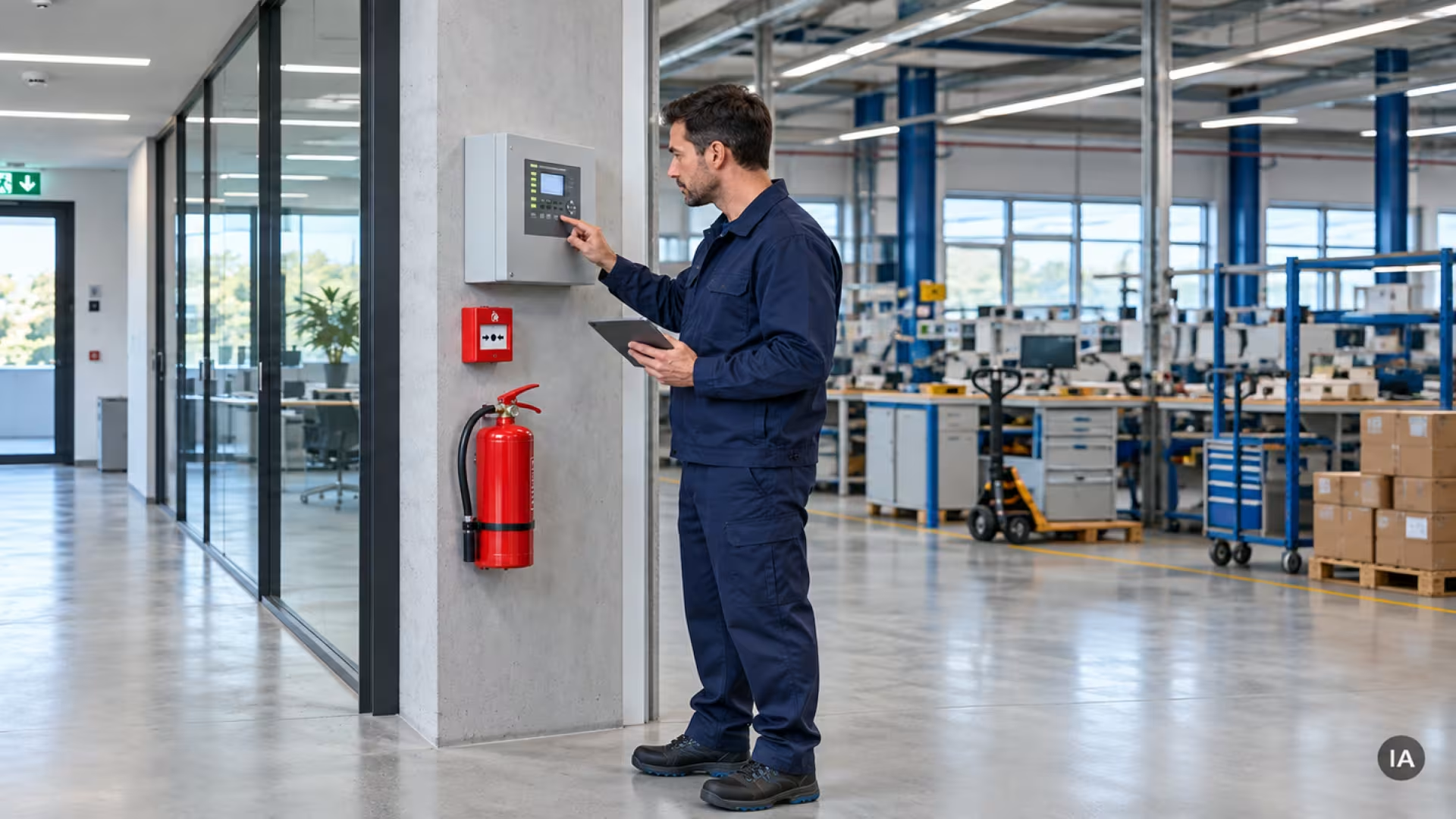
  • Information processing is handled by the fire alarm control unit, often called the fire alarm control panel. It is the brain of the system: it receives signals from the detectors and decides which actions to trigger.
  • Response includes everything that limits the consequences of a fire once the alarm has been raised: audible and visual notification appliances, fire doors that compartmentalize the premises, smoke control systems, and, in some cases, automatic suppression.
Pictogramme utilisateur

Pierre, Fire Safety Systems Technician, Scutum Incendie

“A fire safety system is a chain: detect, analyze, act. If a single link fails (a dirty detector, a poorly programmed control panel, a fire door blocked by a cardboard box), the whole system loses its effectiveness. Our role is to design that chain end to end and to verify that every component responds as intended on the day it is needed.”

Choosing a System Based on Company Size

The number of employees, the number of floors, and the presence of workshops or storage areas directly affect how sophisticated your system needs to be. Here are the main trends, which you can then refine based on your activity.

For Very Small Businesses (Fewer Than 20 Employees, Simple Premises)

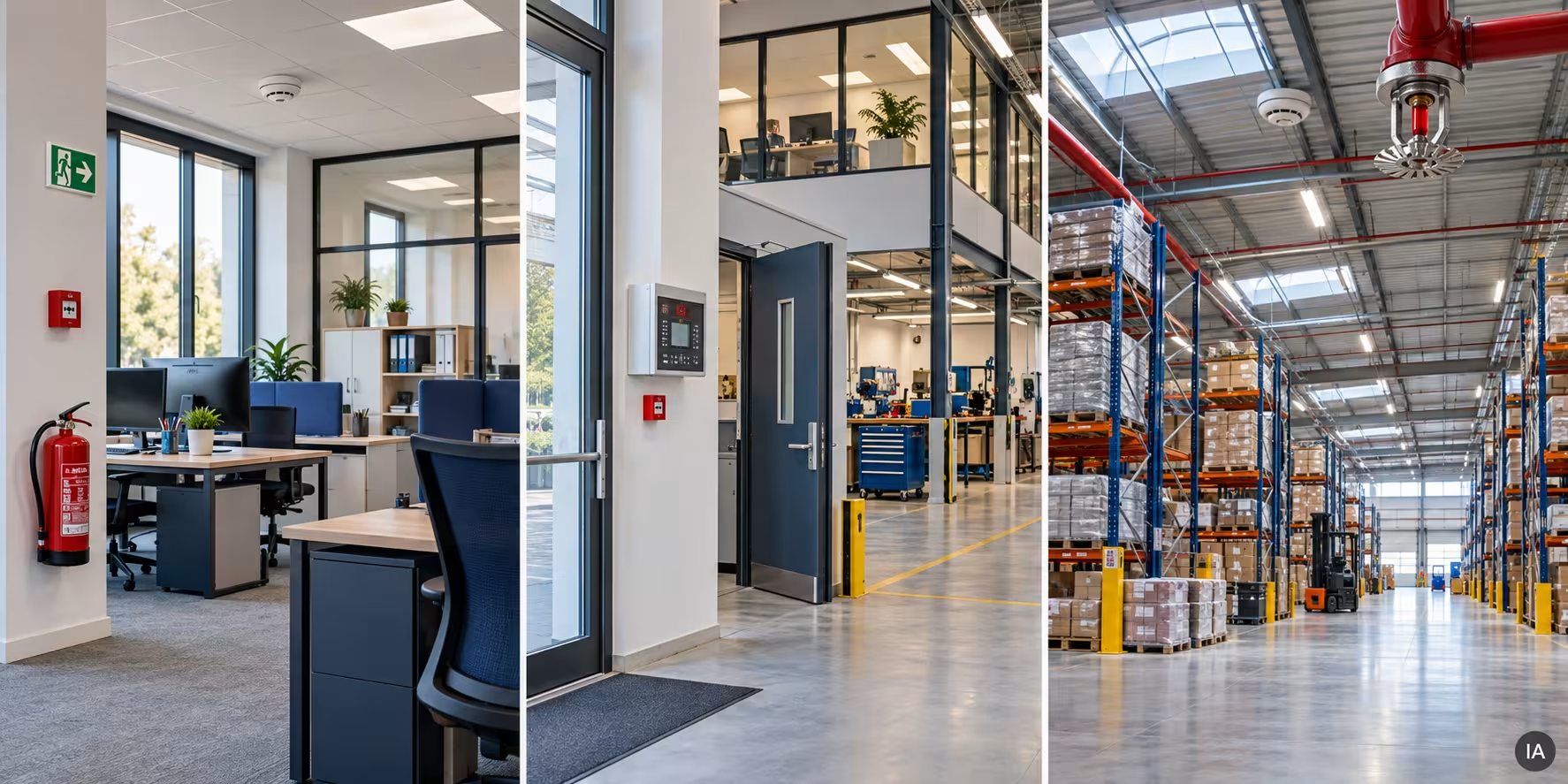
For a small business with simple offices, the essentials come down to a few basic items: suitable fire extinguishers (within a travel distance of 75 feet or less for ordinary combustibles, under OSHA rules), clearly posted safety instructions, and in most cases a simple audible alarm activated by a manual pull station.

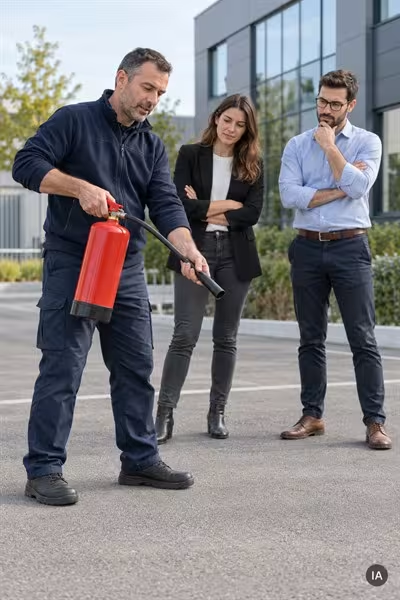
Favor self-contained, easy-to-maintain solutions. The often-overlooked point is training. Knowing how to use a fire extinguisher under stress is not something you can improvise.

In small businesses, the main risk usually comes from aging electrical installations or poorly organized storage areas. A simple assessment can often identify these weak points before they become a problem.

For Small and Midsize Businesses (20 to 250 Employees, Multiple Floors, Workshops, Storage)

Once your business grows, with several floors, a workshop, or a storage area, a simple manual alarm is generally no longer enough. You move up to a more comprehensive system, with a true fire alarm control panel that centralizes information.

Risk areas (mechanical rooms, archives, workshops) require automatic detectors rather than manual pull stations alone. A smoke control system often becomes necessary in stairwells or large open areas.

At this stage, a maintenance contract with a qualified fire protection contractor is no longer a nice-to-have. It is an operational necessity. A poorly maintained system loses all its effectiveness, whatever its initial quality.

For Mid-Market and Large Enterprises (More Than 250 Employees, Multiple Sites, Industrial Facilities)

At this scale, a tailored approach becomes the rule. Every site, every activity, and every building presents specific risks, which makes a fire safety audit essential before any equipment decision.

The most comprehensive systems provide full detection coverage across the entire site and automatically control other equipment: fire doors, ventilation, smoke control. For the most critical areas, such as data centers or high-value warehouses, automatic suppression systems like sprinklers provide an immediate response.

Remote supervision and 24/7 monitoring make it possible to respond within minutes, even outside working hours. This is one of the pillars of truly effective risk management at this scale: your safety equipment must be built into your emergency action plan, so that everyone knows exactly what to do.

Sécurité incendie selon la taille de entreprise
Pictogramme utilisateur

Fabien, Sales Representative, Scutum Incendie

“On an industrial site, we’re not just protecting a building. We’re protecting a production line, inventory, and commitments to customers. Our EHS contacts expect a comprehensive view: an audit by risk zone, systems that communicate with each other, and monitoring that can dispatch a response at any hour. This approach is what turns a regulatory constraint into a genuine risk management tool.”

Overview: What Level of Protection for Your Size?

  Very small businesses (< 20 employees) Small and midsize businesses (20 to 250 employees) Mid-market and large enterprises (> 250 employees)
Main obligation Compliance with OSHA standards to protect people. More complex risk management (storage, mechanical rooms) and stricter compliance. Comprehensive risk management, business continuity, and specific requirements (assembly and mercantile occupancies, high-hazard occupancies).
Recommended system type Often a simple alarm (manual pull station and audible notification), or no centralized system if not required. System with a control panel managing manual pull stations and sometimes a few detectors. The most comprehensive system, covering all areas with automatic detection and controlling other systems.
Key equipment Fire extinguishers, self-contained emergency lighting units, posted safety instructions. Fire alarm control panel, automatic detectors in risk areas, smoke control system. Full automatic detection, automatic suppression, compartmentalization control, 24/7 monitoring.
Maintenance Annual maintenance check of extinguishers (plus monthly visual inspection) and simple maintenance of emergency lighting. Contract recommended. Inspection, testing, and maintenance required (OSHA and local fire code). Maintenance contract with a qualified provider. Comprehensive maintenance contract with on-call service and regular audits.

Other Key Criteria Beyond Size

Company size gives you a first indication, but it is not enough on its own. Other criteria must be taken into account to size your system correctly.

  • The company’s activity: a chemical plant and a communications agency do not face the same risks, even with a similar headcount.
  • The type of building: a wood-frame structure or a high-rise building is subject to specific rules.
  • The value of the assets to protect: a data center, a stock of goods, or sensitive records often justify a higher level of protection.
  • The presence of the public: an occupancy open to the public follows its own rules, often stricter than those for a workplace closed to the public.

Don’t Overlook Maintenance and Staff Training

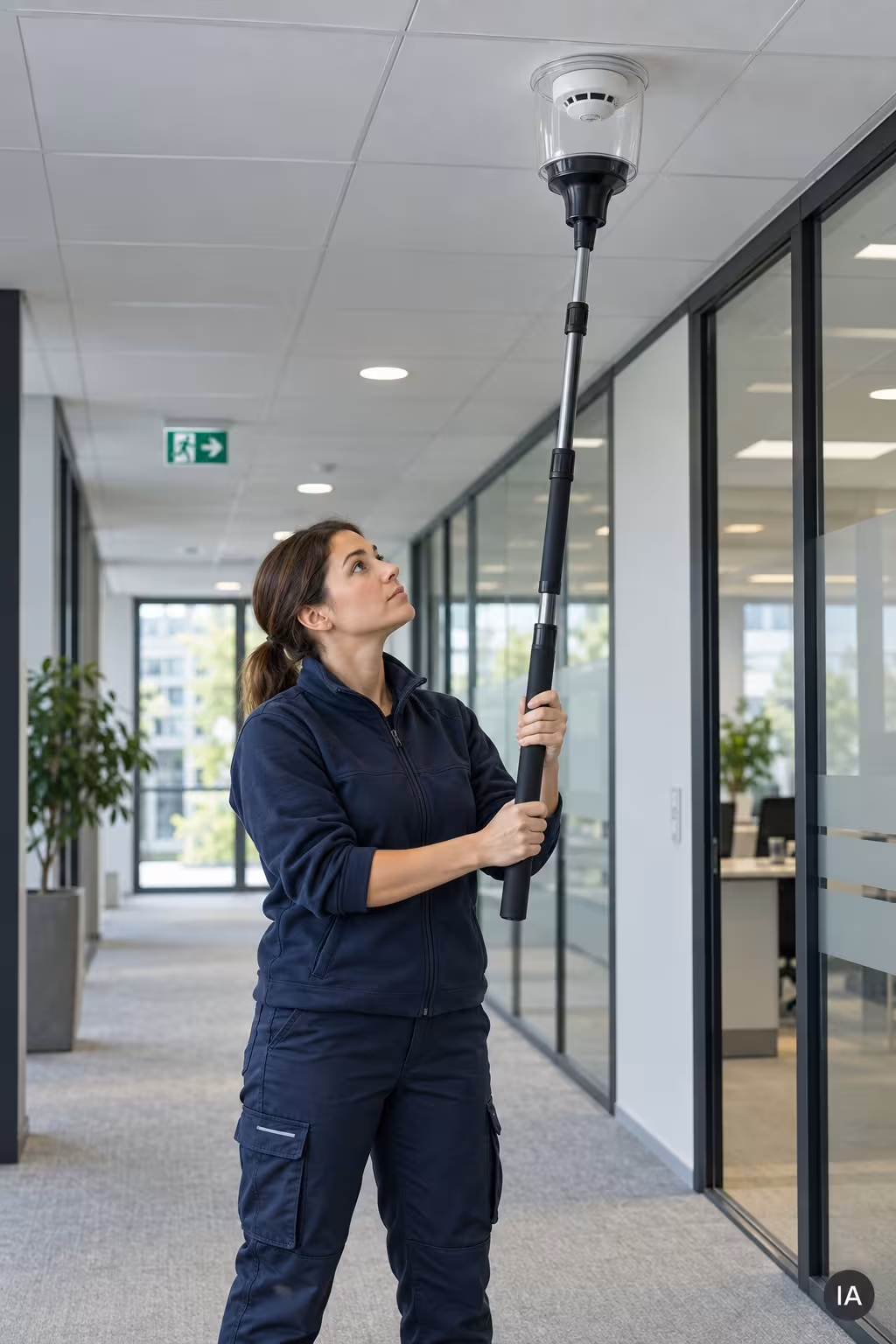
Even the best fire safety system on the market is worthless if it is not maintained. The law requires regular inspections, but beyond the legal obligation, only a maintenance contract managed by a qualified provider (for example, a licensed contractor whose fire alarm technicians hold NICET certification) ensures that your equipment will remain fully operational on the day you need it.

The human factor matters just as much as technology. Regular evacuation drills, trained and clearly identified evacuation wardens, and good knowledge of first-response equipment among your teams often make the difference between a contained incident and a situation that gets out of control.

Formation extincteur
Maintenance détecteur incendie
Pictogramme utilisateur

Sebastien, Branch Manager, Scutum Incendie

“During a maintenance visit to a logistics customer, we found that several detectors in a warehouse had been blocked by new racking. On paper, the site was protected; in reality, an entire zone was no longer being monitored. We relocated the detection and trained the team on site in a single day. That is the whole point of an ongoing maintenance contract: facilities evolve with the business, and protection has to keep up.”

Conclusion: Fire Safety Is an Investment, Not an Expense

Choosing a fire safety system means, above all, choosing a solution that fits the reality of your business: its size, its activity, its buildings, and the assets it houses. Size is a useful first filter, but a customized audit remains the only way to size a system that truly matches what is at stake.

That is exactly where Scutum comes in. For decades, we have supported companies of all sizes, from very small businesses to multi-site industrial groups, with a simple conviction: security cannot be standardized, it has to be tailored. Our risk management expertise and our operational certainty give you clear visibility over your obligations, your priorities, and your investments, at any scale.

Want to know exactly which system is right for your business? Contact our team for a customized assessment.

FAQ: Common Questions About Choosing a Fire Safety System

Can I install a fire safety system myself?

For basic equipment, such as fire extinguishers or standalone smoke alarms, yes, in most cases. However, as soon as you are dealing with a complete system with a fire alarm control panel, installation by a qualified professional is essential. It is the only way to ensure that your installation is code-compliant and works properly on the day it actually needs to activate.

What is a business owner’s liability for failing to meet fire safety obligations?

A business owner can be held liable both civilly and criminally. In the event of an accident, if a failure is established (lack of maintenance, lack of training), criminal liability may follow: a willful violation of an OSHA standard that causes an employee’s death is a federal criminal offense, and state criminal laws may also apply. On the insurance side, failing to meet contractual obligations, which are often aligned with regulations, can also lead the insurer to deny coverage for the damage.