In this article, we will clarify the key differences, explain how each solution works and help you choose the one that best meets your business needs.
→ The key takeaway:
Video surveillance allows you to see.
Remote monitoring allows you to act.
published on 17/08/2026
Written by Magali Belot
Written by Magali Belot
In the business world, the terms video surveillance and remote monitoring are often confused. Many businesses assume that they are equivalent solutions, when in reality they address very different needs.
This confusion can have a direct impact on your level of security. By choosing an unsuitable system, you may not be sufficiently protected in the event of an incident.
In this article, we will clarify the key differences, explain how each solution works and help you choose the one that best meets your business needs.
→ The key takeaway:
Video surveillance allows you to see.
Remote monitoring allows you to act.
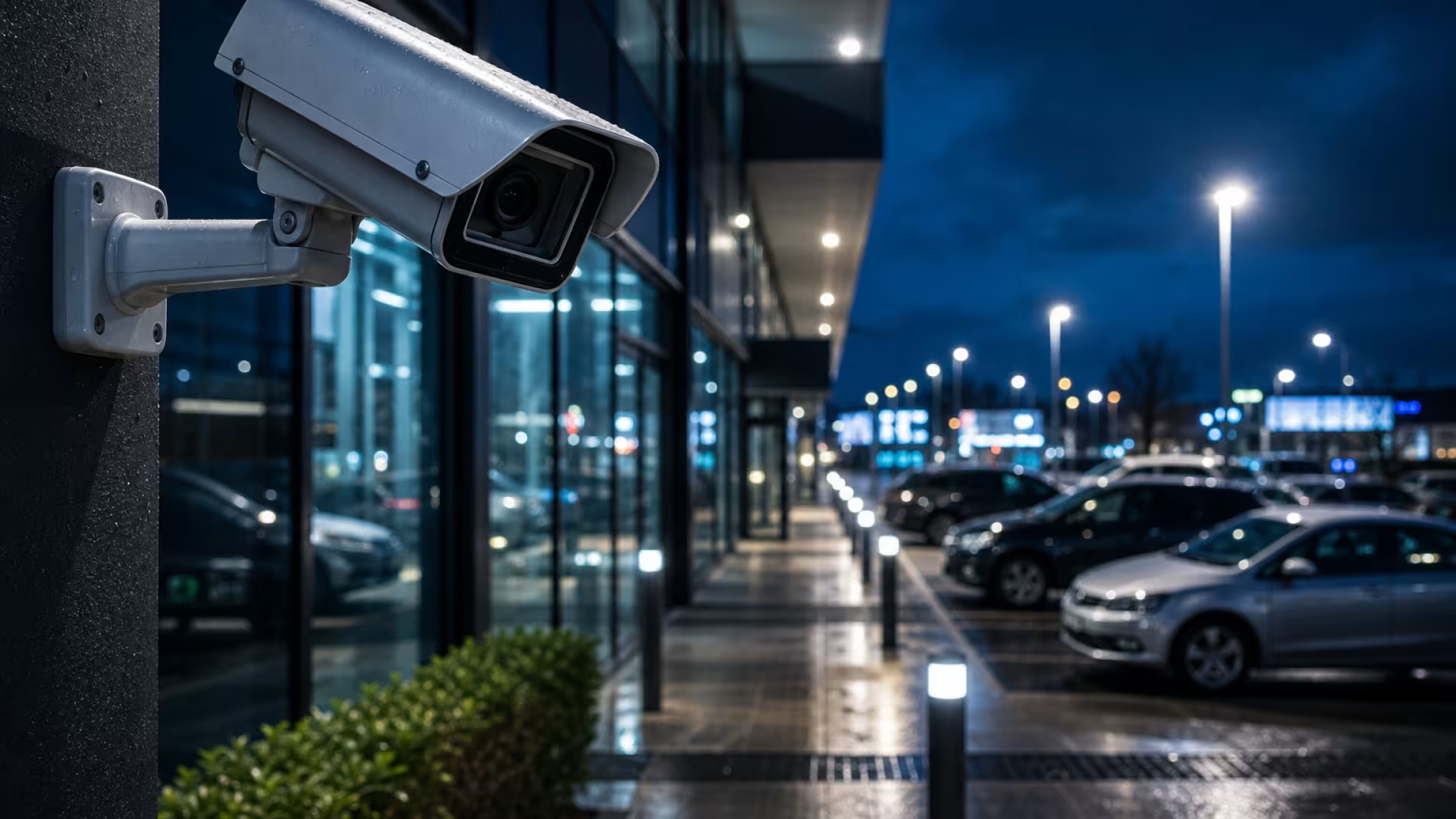
Video surveillance is primarily a system for capturing images. It allows you to monitor an area and record what happens there, either continuously or at specific times.
In practice, cameras are installed in the areas to be monitored. They transmit footage to a recording system, which stores it for later review. The principle is relatively straightforward: cameras capture images, a recorder stores them, and an interface allows authorised users to access the footage either on site or remotely.
The main objective is twofold. On the one hand, the presence of cameras acts as a deterrent. On the other, recorded footage can provide evidence in the event of theft, intrusion or property damage.
This is also where its main limitation lies. Video surveillance does not intervene in real time. In the event of an incident, it documents what happened but cannot itself prevent the incident from occurring or respond immediately.
→ It is therefore a passive system: it observes but does not act.
Remote monitoring follows a completely different approach from video surveillance. The objective is no longer simply to observe, but to respond immediately when an issue occurs.
The process is straightforward: as soon as a suspicious event is detected – such as an intrusion, unusual movement or a door being opened – an alert is automatically transmitted to a remote monitoring center.
This center is staffed by trained security operators who respond in real time. Their role is essential: they immediately analyze the situation, determine whether there is a genuine threat and filter out potential false alarms. This stage, known as alarm verification, makes it possible to confirm whether an incident is genuine before any further action is taken.
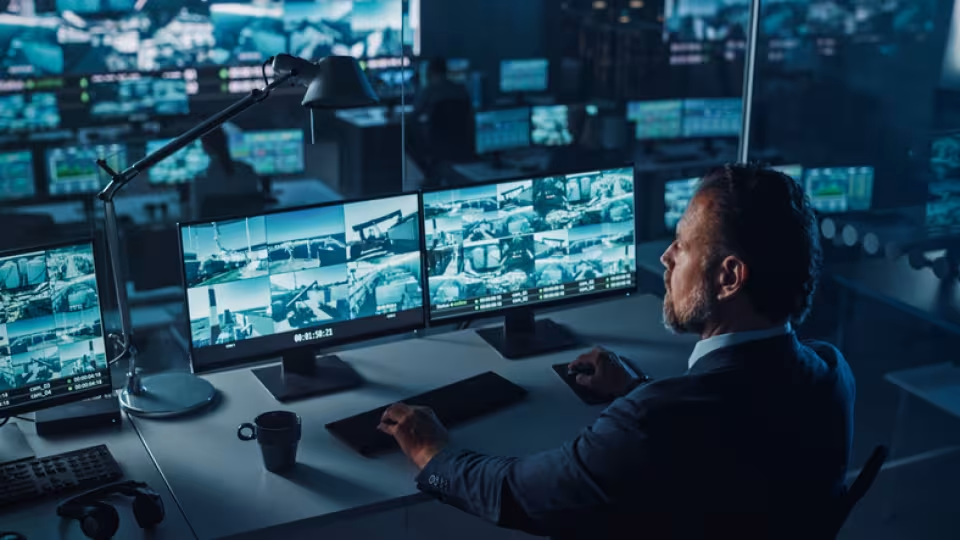
Once a threat has been confirmed, the operator initiates the procedure agreed upon with the business. Depending on the situation, they may contact the site manager, dispatch a security officer to the site or notify the appropriate authorities.
Remote monitoring relies on a range of interconnected equipment and services. These include an alarm system with detectors, cameras used for alarm verification, a secure connection and, above all, a remote monitoring center operating 24 hours a day, 7 days a week.
Unlike video surveillance, remote monitoring is therefore an active service that combines technology with human intervention to provide real-time protection.
The first difference concerns the speed of response.
Video surveillance allows footage to be reviewed after an incident, once it has already occurred.
Remote monitoring, on the other hand, enables immediate response, often within seconds of an alarm being triggered.
With video surveillance, no action is automatically triggered. You must identify the incident yourself and manage the necessary response.
With remote monitoring, an operator takes charge of the situation and follows a predefined procedure, ensuring a structured and appropriate response.
The purpose of video surveillance is to deter malicious behavior and provide usable evidence following an incident.
Remote monitoring aims to prevent an incident or stop it as quickly as possible by responding to the first signs of an abnormal situation.
Video surveillance involves an initial investment in purchasing and installing the equipment.
Remote monitoring generally includes a monthly subscription, covering an ongoing service with monitoring 24 hours a day, 7 days a week.

Video surveillance can help reduce intervention costs.
At some sites, false alarms can occur, for example because of animals or adverse weather conditions. The only way to check that everything is in order may be to send a security officer to the site. This can quickly become expensive.
One way of reducing intervention costs is to equip the site with cameras connected to a remote monitoring service. This enables remote alarm verification, potentially avoiding the need to send a security officer to the site. The result: greater efficiency and lower costs.
For example, a national sporting goods retailer reduced its spending on on-site security personnel by 30% by implementing video patrols: three five-minute video checks, every 20 minutes, over a one-hour period, to ensure that everything was in order.
Video surveillance is subject to the applicable data protection and privacy regulations in the country and jurisdiction where the system is operated. Businesses must comply with requirements relating to transparency, information, privacy and the protection of personal data.
Depending on the country, sector and nature of the security service, remote monitoring may also be subject to additional legal and regulatory requirements. Businesses should therefore ensure that their security systems, procedures and service providers comply with the regulations applicable to their operations.
The choice depends primarily on your activity, your level of risk and what you want to protect.
In practice, many businesses underestimate their security requirements and assume that a camera system alone is sufficient.
This is why it is essential to adopt an approach tailored to your specific circumstances on site.
Video surveillance is an appropriate solution if your main objective is to monitor an area and retain evidence in the event of an incident.
It is particularly suitable if:
In this case, it provides a first layer of security that is relatively straightforward to deploy and effective in helping to discourage risky or unwanted behavior.
Remote monitoring becomes particularly important when security risks are higher. It enables you to actively protect your site and respond quickly when an alarm is triggered.
It is recommended if:
Through continuous monitoring and operator intervention, remote monitoring provides a high level of protection and greater control over security risks.
In many cases, the most effective solution is to combine video surveillance and remote monitoring. This approach brings together the strengths of both systems, combining image capture with the ability to respond in real time.
Cameras are no longer used simply to record footage. They become a genuine decision-making tool, enabling remote monitoring operators to carry out faster and more reliable alarm verification, accurately assess the situation and adapt their response accordingly.
This combination also improves the overall responsiveness of the security system. By accessing live images, remote monitoring teams can make decisions more quickly and trigger more appropriate responses.
→ It is no longer simply a monitoring system, but a complete security solution that is both preventive and reactive.
The difference between the two solutions is clear:
The right choice depends on your circumstances, your level of risk and the value of what you want to protect. However, businesses are increasingly opting for a combined approach that provides greater security and more effective protection.
To take things further, a security audit can help identify your specific requirements and determine the most suitable solution.
Video surveillance mainly involves an initial cost for purchasing and installing cameras. Once the system is in place, ongoing costs are generally limited.
Remote monitoring, on the other hand, includes a monthly subscription, as it provides an ongoing service: 24/7 monitoring, alarm handling and intervention when necessary.
The service therefore involves recurring costs, but provides a higher level of security, particularly for businesses looking to prevent financial losses or intrusions.
Yes, absolutely. You can install cameras that record footage and access the images remotely whenever you need to.
This is a simple and more cost-effective solution, often used as a first security measure.
However, it is important to remember that:
→ no one will automatically intervene if a problem occurs.
The response depends entirely on you or the people responsible for security.
Whether you use a video surveillance system or a remote monitoring system, you must comply with the applicable data protection and privacy requirements.
The exact rules vary depending on the country and jurisdiction. For example, businesses operating in the UK must take into account the UK GDPR, the Data Protection Act 2018 and applicable guidance on video surveillance. In the United States, requirements can vary at the federal, state and local levels.
In practice, this includes:
Businesses should also maintain appropriate records and procedures to document how personal information collected through these systems is used.
→ The aim is to strike the right balance: ensuring the security of people and property while respecting individual rights and privacy.