Submitted by Joe Semaan on
badge-biometrie-scene-unifiee-ia.webp
published on 30/10/2026

Access Cards vs. Biometrics: Which System Should You Choose to Secure Your Business?

Written by Jonathan Tripier

Introduction to Workplace Access Control

Protecting your premises means protecting much more than walls. It means safeguarding sensitive data, production equipment and, above all, the people who work there every day. As intrusion attempts and security threats continue to rise, access control has become an essential part of business security strategies.

Access control refers to the technical and organisational measures used to grant or deny a person entry to a specific location. It involves verifying an identity or access permission before a physical entry point is unlocked.

Two main types of solutions dominate the market today: access cards and biometrics. Each works in a different way, with its own strengths and limitations. The choice between these systems depends on several factors: the available budget, the level of security required for the areas being protected, and the legal framework established by the UK GDPR and the Information Commissioner's Office (ICO). This article explains the considerations behind each technology to help you choose the solution best suited to your business.


Card-Based Access Control: A Well-Established, Proven Solution

Access cards remain one of the most widely used solutions in businesses. Simple and quick to deploy, they have a long track record.

How Does an Access Card Reader Work?

An RFID access card reader uses contactless identification. The chip embedded in the card sends a signal detected by the reader, which then checks the access permissions associated with that identifier. Several technologies are available:

RFID (Radio Frequency Identification) remains the most widely used technology for business access control. NFC (Near Field Communication), a more recent technology, enables very short-range communication and can be easily integrated into smartphones. MIFARE has also become an established standard, recognised for its encryption capabilities and reliability.

There are also physical access cards, in the form of cards or key fobs, and virtual credentials stored directly in a mobile app. The latter format is becoming more common, particularly because it removes the need to manage physical credentials and makes remote access revocation easier.

The Benefits of Access Cards for Businesses

Access cards are popular first and foremost because they are simple. Here are the main advantages behind their lasting success:

  • Quick deployment: an access card system can generally be installed within a few days, without major building work.
  • Controlled costs: readers and cards remain affordable, even for small and medium-sized businesses with limited budgets.
  • Ease of use: employees do not need any special training.
  • Immediate revocation: if a card is lost or an employee leaves, access can be deactivated in just a few clicks, without having to change the locks.

The Limitations and Security Vulnerabilities of Access Cards

Access cards are not foolproof. Their main weakness lies in their very nature: they are physical objects, and objects can be lost, stolen or lent to someone else.

  • Loss or misplacement: a lost card creates an immediate security gap, especially if it is not reported promptly.
  • Sharing between colleagues: this fairly common practice undermines the principle of individually traceable access.
  • Cloning risk: older cards using basic 125 kHz chips can be copied in minutes with readily available equipment. Newer cards using encrypted technologies such as MIFARE DESFire are much more resistant to this type of attack.

These vulnerabilities do not undermine the value of access cards for general entry, but they do show their limitations when a higher level of security is required.

GettyImages-1340936123.jpg

Biometrics in the Workplace: A Higher Level of Security

Whereas access cards rely on an object, biometrics rely on the individual themselves. This difference changes the equation, particularly when protecting the most sensitive areas.

What Biometric Technologies Are Available?

Several biometric access technologies are available, with varying levels of reliability and cost.

Fingerprint recognition remains the most common and established technology, having been used for years across many industries. Facial recognition and iris recognition are developing rapidly, particularly because they are convenient and require no physical contact. Finally, vein pattern recognition offers one of the highest levels of security available, as these patterns are extremely difficult to falsify or replicate.

The Main Benefits of Biometric Systems

The key advantage of biometrics is straightforward: the identifier is you. It cannot be lost, lent to someone else or stolen in the same way as a card.

This level of security makes biometrics a reference solution for highly sensitive areas, such as server rooms, research laboratories and executive areas. User convenience is another significant benefit: there is no need to search for an access card at the bottom of a bag. Access can feel seamless and, depending on the technology, may even be contactless.

GettyImages

The Constraints of Biometrics: UK GDPR and ICO Requirements

Biometrics involve particularly sensitive information about the human body. In the UK, when biometric data is used to uniquely identify someone, it is treated as special category personal data under the UK GDPR. Its use is therefore subject to specific legal requirements and safeguards.

The central principle is necessity and proportionality. In practice, a business cannot deploy biometrics for just any purpose: it must be able to demonstrate that this level of security is necessary and proportionate to the sensitivity of the location or the information being protected. Securing access to ordinary administrative offices may not, in itself, justify the use of biometrics.

One point deserves particular attention: using biometrics in the workplace, including for employee time and attendance recording, is not automatically prohibited in the UK. However, where biometric data is used to identify workers, employers must identify both a lawful basis under Article 6 and a separate condition under Article 9 of the UK GDPR. The ICO considers this processing high risk and says a data protection impact assessment (DPIA) must be completed before it begins. Employers should consider less intrusive alternatives, such as access cards or PINs. Where consent is relied upon, workers must have a genuine choice and a practical alternative without disadvantage; consent is often difficult to rely on in employment because of the imbalance of power between employer and worker.

Finally, installation costs are generally higher than for card-based systems, owing to the sensors and associated processing software.

entreprise
GettyImages

Direct Comparison: Access Cards or Biometrics, Which Should You Choose?

There is no one-size-fits-all answer. The right choice depends on the size of your business and, above all, the areas you need to protect. The entrance to an industrial site does not have the same security requirements as a server room or an R&D laboratory.

For a small or medium-sized business with typical employee traffic, access cards are often the most relevant choice: simple, cost-effective and sufficient for general access. For a large organisation with areas of significant strategic value, a differentiated approach may be appropriate, with biometrics used at selected critical access points.


The table below summarises the main criteria to consider when making your decision.

Evaluation criteria Card-Based Access Control Biometric Access Control
Installation and equipment cost Low to moderate (affordable readers, very low cost per card) High (expensive biometric sensors and complex processing software)
Security level Medium to high, depending on the chip's encryption Very high; the identifier is inherent to the individual
Risk of breaches or fraud Theft, loss, forgetting, sharing between colleagues, cloning of older cards Very low; the individual's physical presence is required
Legal compliance and data protection Generally simpler, but still subject to data protection requirements Strict requirements apply: necessity, proportionality, an Article 6 lawful basis, an Article 9 condition and a DPIA where biometric data is used for unique identification
Maintenance and HR administration Time-consuming: replacing lost cards and managing day-to-day forgotten cards Low; no physical credential to manage and the identifier itself cannot be lost
User convenience Fast and familiar, but users need to carry a credential Seamless, with no physical credential to carry, depending on the technology
Ideal use case General building access, high employee traffic, time recording where justified and compliant Highly sensitive areas: server rooms, R&D, executive areas

Hybrid Solutions: Combining Access Cards and Biometrics

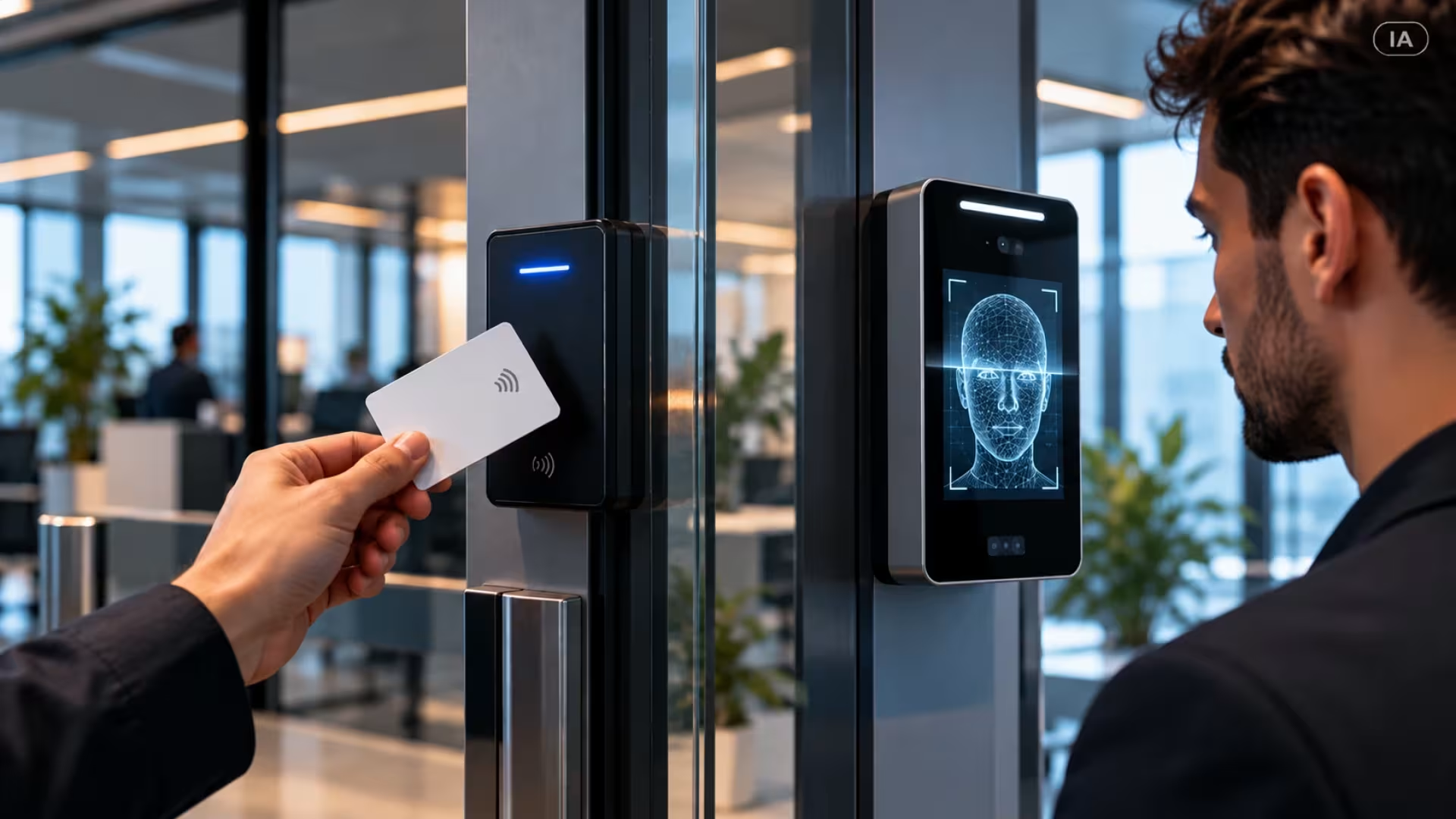
Between an all-card and an all-biometric approach, there is a third option: combining the two. This is known as multi-factor authentication (MFA), applied to the physical world rather than just digital systems.

The idea is simple: to enter a critical area, a person must present both an access card and biometric identification. This double check significantly reduces the risk of unauthorised access, even if the card is stolen.

This approach can also help balance security and privacy when designed carefully. Rather than storing every employee's biometric data in a central database, which could be vulnerable in the event of a breach, one possible technical architecture is to store the biometric template on the individual's access card. In that configuration, the template is not held in a central database. This approach does not automatically ensure compliance: its suitability depends on the applicable legal requirements, the system's technical safeguards and how the data is used.

Pictogramme utilisateur

Jonathan Tripier – Pre-Sales Engineering Manager

"Choosing between access cards and biometrics is not simply a matter of technology; it requires an overall assessment of risk. In a context shaped by ANSSI recommendations and the growing requirements of the Cyber Resilience Act, securing physical and digital identities has become a central issue. Systems engineering makes it possible to define the most appropriate level of authentication for each access point while ensuring that the infrastructure remains resilient to physical and cyber threats." 

Conclusion

Access cards or biometrics: there is no universal answer, only a solution suited to your circumstances. Access cards remain a reliable and cost-effective standard for general access to your premises. Biometrics, meanwhile, are best reserved for areas where even a minor security breach could have serious consequences.

The right strategy often involves combining the two approaches according to the areas being protected, with support from specialists who can assess your actual needs. That is the value of a security audit carried out by experts who understand both the available technologies and the regulatory requirements that govern their use.

Would you like to review which access control system is best suited to your business? Scutum experts can support you from the security assessment of your premises through to the installation of the solution most appropriate for your operations.

FAQ: Frequently Asked Questions About the Differences Between Access Cards and Biometrics

Can biometrics legally be used for employee time and attendance recording?

Yes, it may be possible in the UK, but it is not automatically justified. If biometric data is used to uniquely identify employees, it is special category data under the UK GDPR. Employers need an Article 6 lawful basis and an Article 9 condition, and the ICO requires a DPIA before this high-risk processing begins. Less intrusive alternatives should be considered, and workers must have a genuine alternative without disadvantage if consent is used.

Does a biometric system store every employee's fingerprints?

Not necessarily. A biometric system does not have to store raw fingerprints in a central database. Depending on the system design, it may store a biometric template on an individual credential, such as an employee's access card. The storage method should be assessed against the applicable legal requirements and security safeguards.

Can an access card be hacked or copied?

Yes, particularly older technologies such as 125 kHz chips, which can be cloned relatively easily. Modern cards using encrypted protocols, such as MIFARE DESFire, are much harder to copy.