Submitted by Justine.Pource… on
The Alexandria Library
published on 22/03/2026

The Burning of the Library of Alexandria

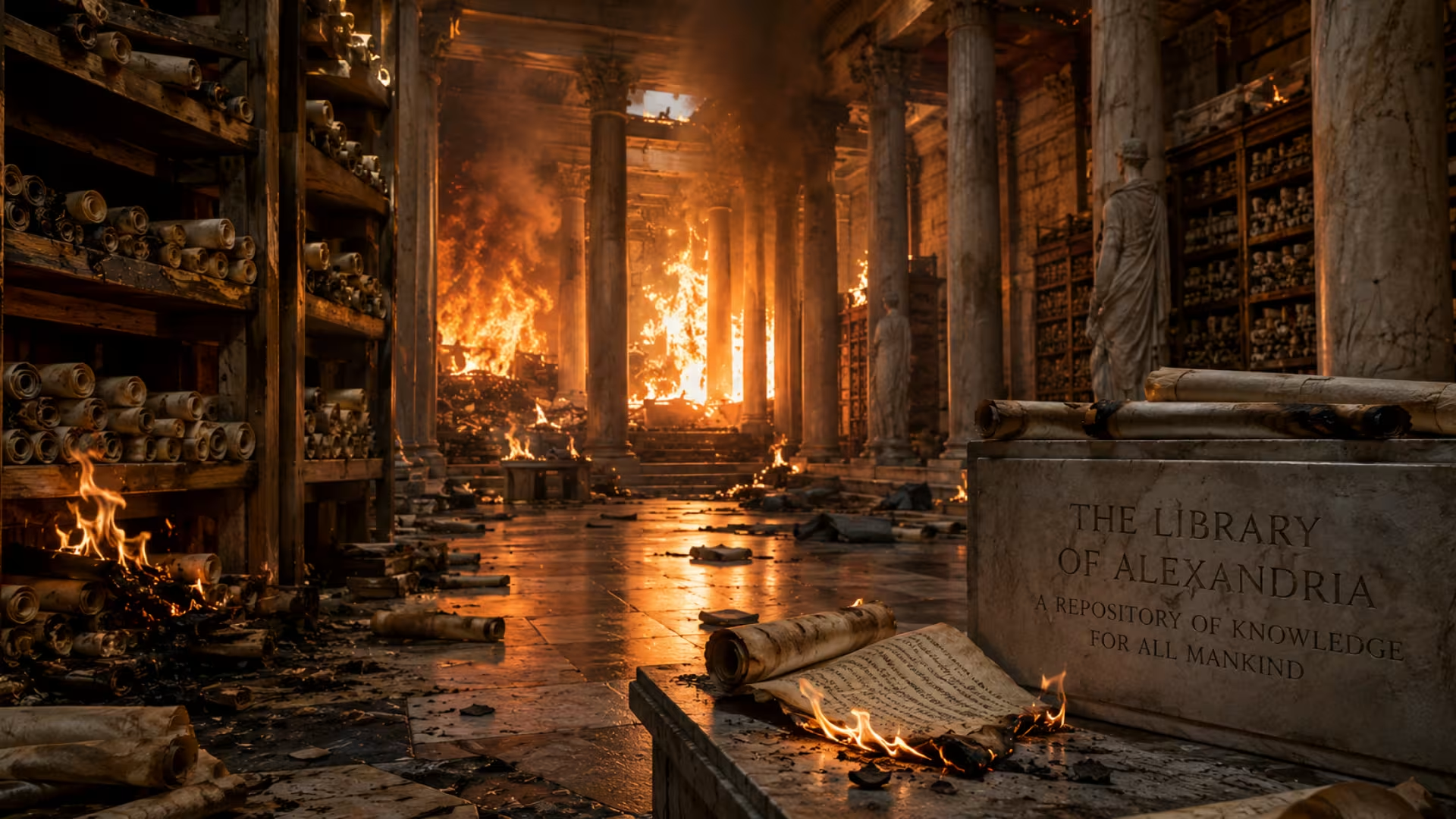
The Library of Alexandria was one of the greatest centres of knowledge in the ancient world, housing vast collections of manuscripts and scholarly works. Its decline and eventual destruction highlight the devastating impact fire can have on irreplaceable assets.
Today, this story serves as a powerful reminder of the importance of fire prevention, detection and protection.

The Origins and Importance of the Library of Alexandria

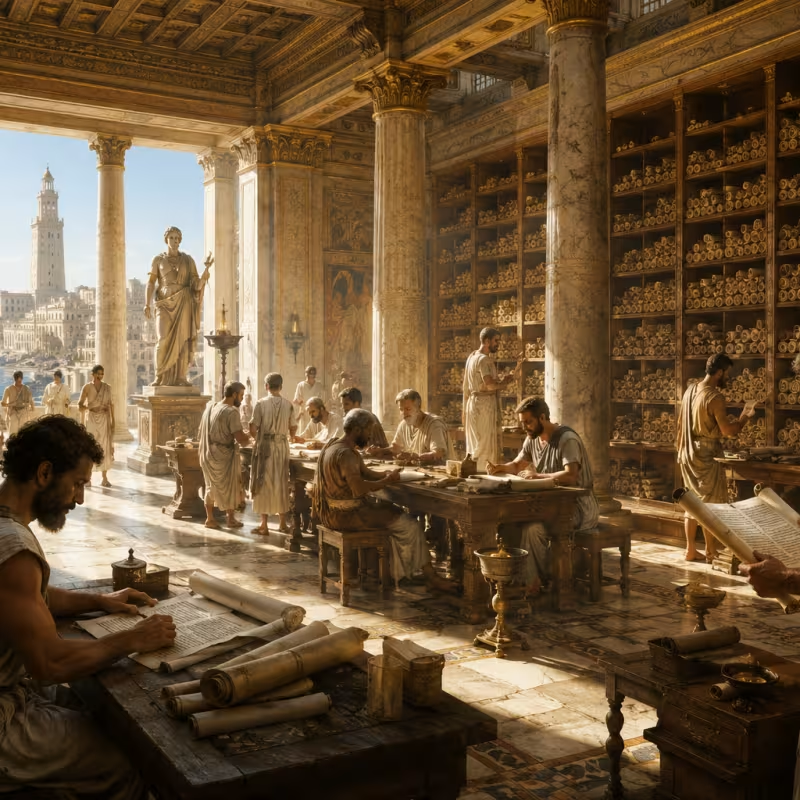
Founded in the ancient city of Alexandria in Egypt, situated on the Mediterranean coast and named after Alexander the Great, the Library was established during the reign of Ptolemy II Philadelphus, who reigned from 283 to 246 BCE. At its peak, it held an extraordinary collection of texts, with estimates ranging from 40,000 to as many as 400,000 scrolls.

Library of Alexandria.png
Pencil

The Library's mission

The Library's mission was to collect and preserve knowledge from across the known world. This was achieved through extensive acquisition efforts, including copying texts from visiting ships and sourcing manuscripts from different regions, making it one of the most important intellectual centres of its time. Ptolemy II's reign also saw the construction of another great Alexandrian landmark: the Lighthouse, one of the Seven Wonders of the Ancient World.

The Early Decline of the Library

Contrary to popular belief, the Library of Alexandria was not destroyed in a single catastrophic event. Its decline began well before any fire. As early as 145 BCE, following a dynastic conflict, Pharaoh Ptolemy VIII Physcon expelled all foreign scholars from the city. Although Alexandria itself continued to be a centre for study, much of its intellectual activity was no longer connected to the Library. The institution nevertheless continued to hold a large archive of works.

The Fire of Julius Caesar and the Loss of Scrolls

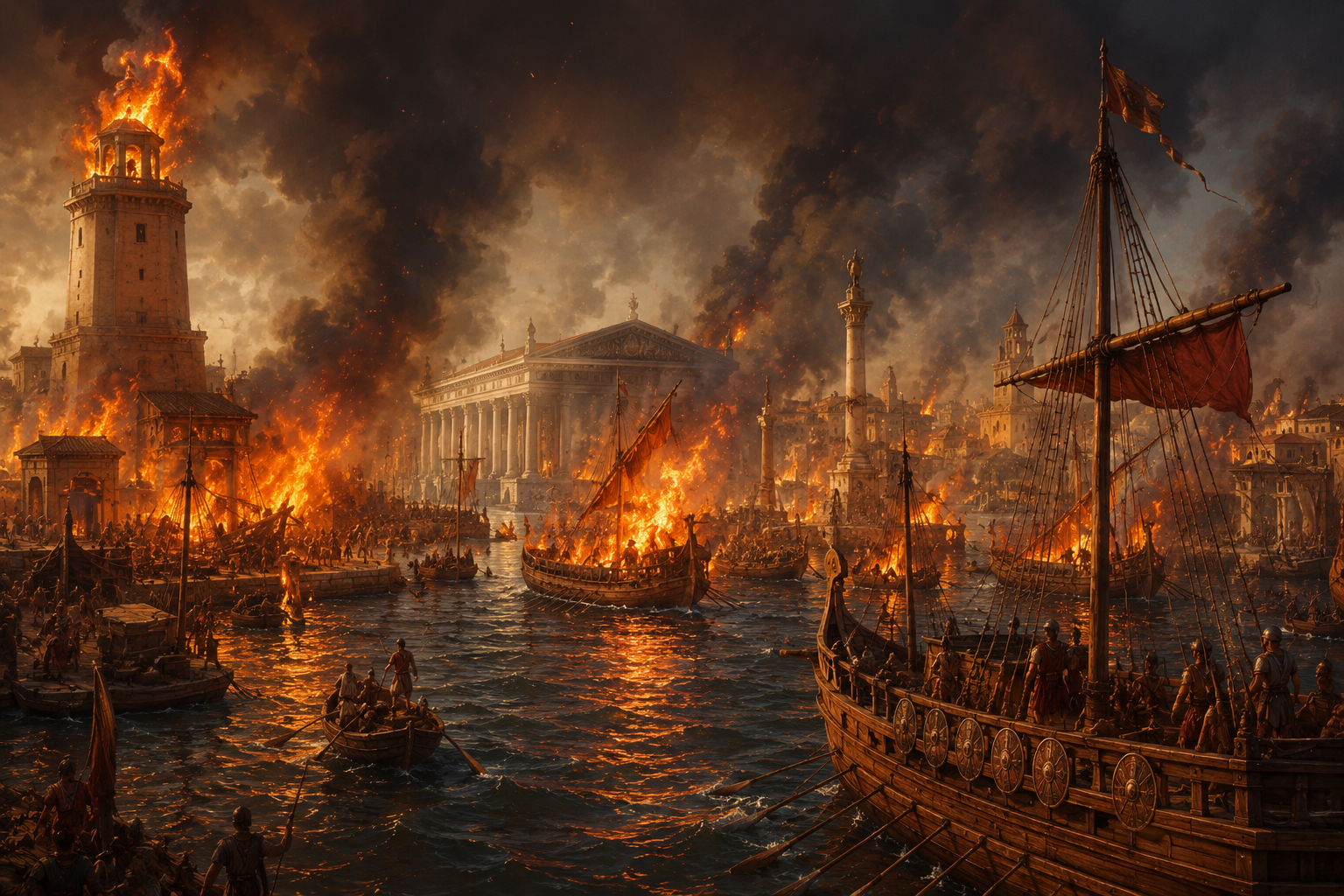
One of the most significant incidents in the Library's history occurred in 48 BCE, when Julius Caesar was besieged at Alexandria during his ongoing civil war with Gnaeus Pompeius Magnus, also known as Pompey the Great. According to some accounts, in order to block the fleet of Ptolemy XIV, his troops set fire to ships in the port. The fire spread along the docks and eventually consumed parts of the Library.

According to the Roman historian Livy (59 BCE – 17 AD), around 40,000 scrolls were destroyed in this incident. However, the Roman historian Cassius Dio (155 – 235 AD) offers a more nuanced account, suggesting that storehouses of grain and books were burned, implying that while valuable texts were indeed lost, the Library itself may not have been substantially damaged as an institution. The fire spread along the docks, causing significant destruction to the surrounding area.

Historical accounts suggest that this did not completely destroy the institution. The Library continued to function in some capacity in the years that followed, although without the same standing and respect it had previously enjoyed.

The library of Alexandria 2.png

The Final Destruction of the Library

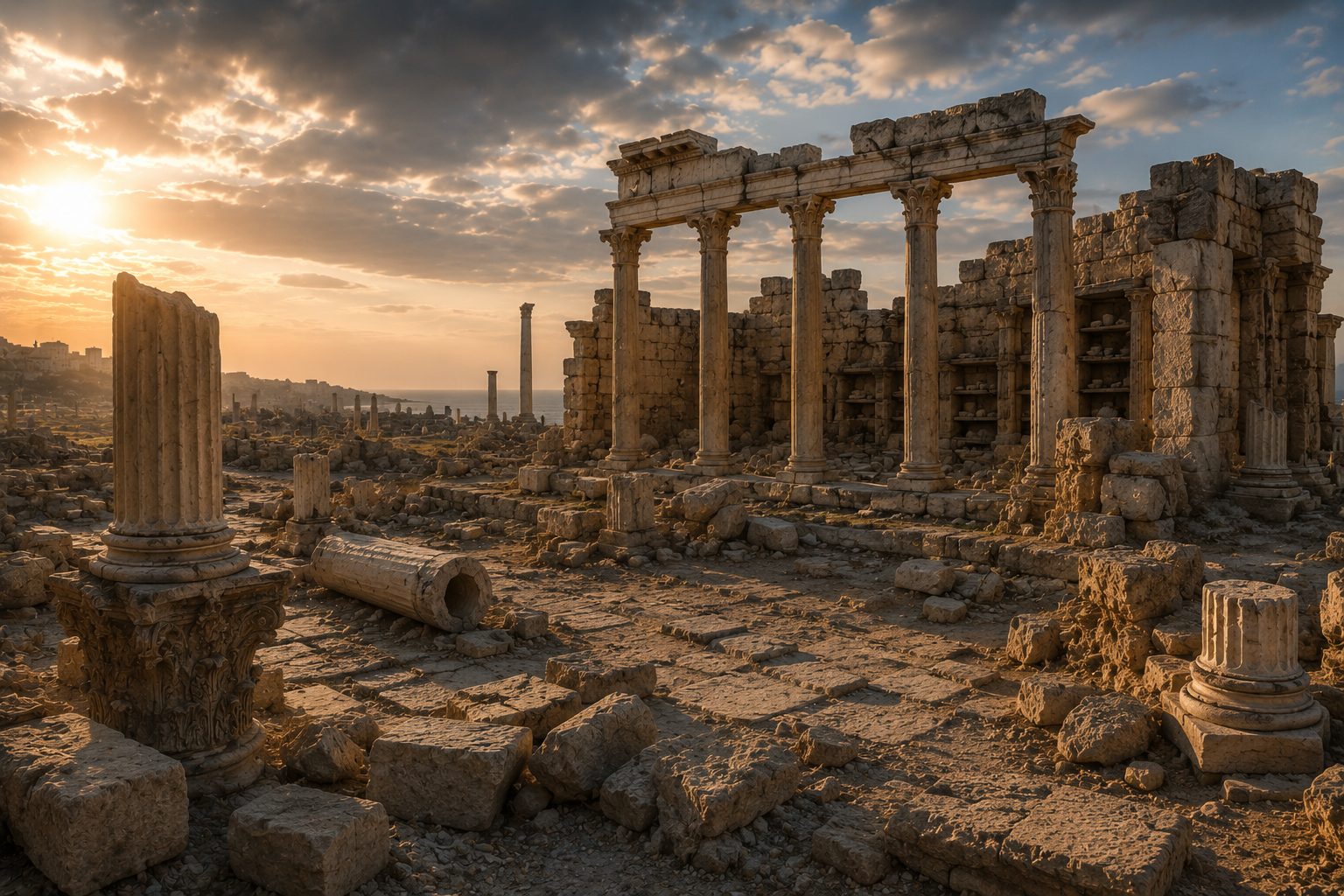
The Library continued to decline over the following centuries, shaped by political instability and the gradual removal of scholars from the city. As Alexandria fell under Roman hegemony, it became less and less important as a centre for learning. The institution was eventually destroyed during later conflicts in the third century AD, either during the Emperor Aurelian's siege of 272 AD or during the reign of the Emperor Diocletian in 297 AD.

The gradual nature of the Library's loss makes it all the more instructive. It was not a single fire that erased centuries of knowledge, but a combination of political instability, neglect and repeated damage over time, a reminder that even the most significant assets can be lost without consistent protection and care.

Library of Alexandria 3.png

The Legacy of the Library of Alexandria

The myth of the burning of the Library of Alexandria, along with other major fires that have changed the course of human history, demonstrates the monumental power that fire holds over us. It has the potential to destroy much of what we hold dear, whether that be our homes and livelihoods, or less tangible things like knowledge and wisdom.

Today, with a commitment to stringent fire safety measures, particularly in the areas of prevention, detection and control, businesses and organisations are required to carry out certain measures to reduce the risk of fire. Any building that regularly contains at least five people, excluding private homes, must carry out regular fire risk assessments to identify and remove potential fire hazards.

The story of the Library of Alexandria is a compelling illustration of what can be lost when fire protection is inadequate. Whether your premises houses documents, equipment, stock or people, the principle is the same: prevention and early detection are always the most effective tools available.
Protect What Matters

Don't wait for an incident to act. Contact Scutum today to arrange a fire risk assessment, fire alarm installation or fire safety review — and ensure that what matters most to your organisation is never left unprotected.