Submitted by Justine.Pource… on
Chantiers isolés.png
published on 13/08/2026

Construction Site Security Against Theft, Intrusion and Vandalism

Written by Eric Wolf

Long considered a secondary concern, construction site security has now become a major strategic issue for players in the construction industry. In an environment marked by increasingly complex projects, a growing number of stakeholders and rising risks, failing to effectively secure sites is no longer an option. It poses a direct risk to project performance, profitability and successful completion.

The construction industry is one of the major pillars of the French economy. In 2024, it generated more than €208 billion in revenue, according to the Fédération Française du Bâtiment, driven by increasingly ambitious infrastructure, urban development and industrial construction projects.

However, this growth is accompanied by a profound transformation of working environments. Construction sites are becoming larger and more technically complex and involve an increasing number of stakeholders. Often located in remote or difficult-to-access areas, they contain high-value equipment and materials and expose companies to growing risks.

In this context, construction site security and the protection of remote sites can no longer be viewed as a purely operational issue. They have become a strategic priority, at the heart of overall project performance.


An increasingly exposed environment

The construction industry operates in a demanding environment characterised by growing project complexity, tight deadlines and increasing cost pressures.

By their very nature, construction sites are vulnerable environments. Their temporary nature, open layout and constant evolution make them particularly challenging to secure. Unlike fixed industrial sites, they require security measures to be continuously adapted.

Whether they involve major infrastructure projects, property developments or remote sites, certain vulnerabilities are recurring:

  • multiple access points that are difficult to control
  • limited monitoring outside working hours
  • the presence of valuable equipment and materials

These characteristics make construction sites prime targets for malicious activity.

Theft, intrusion and vandalism: a chain reaction of consequences

The increase in security incidents on construction sites is now a well-documented reality. Equipment theft, intrusion and acts of vandalism affect businesses across the industry.

Their impact goes far beyond the immediate loss.

Theft, intrusion and vandalism result in work stoppages, project delays and increased costs, while also disrupting teams on the ground. Added to this are significant contractual risks, which can even lead to financial penalties and undermine the overall performance and profitability of projects.

Even a single incident can throw the entire schedule off balance. In already complex projects, such disruptions can trigger domino effects that are difficult to control.

Construction site security is therefore becoming a major economic issue, directly linked to the profitability and successful completion of projects.

Icon personne

“Faced with growing risks, construction site security can no longer be treated as a secondary concern. It must be considered from the project design stage, based on solid fundamentals – risk anticipation, access control, equipment protection, continuous monitoring, traceability and team awareness – while evolving to adapt to increasingly dynamic environments.”


Eric Wolf, Technical Manager at Scutum

Rethinking construction site security from the project stage

The limitations of traditional approaches

Historically, construction site security relied mainly on manned guarding and fixed security systems. While these solutions remain relevant in certain contexts, they are increasingly showing their limitations.

Manned guarding can be costly and difficult to maintain across large sites. It also does not guarantee consistent coverage, particularly over long periods.

Fixed infrastructure, meanwhile, lacks flexibility. It is often unsuitable for constantly evolving construction sites and requires significant deployment time.

Finally, the lack of real-time supervision limits the ability to respond quickly, even though rapid intervention is essential to preventing incidents.

These constraints call for a transformation in security approaches.

Towards smarter and more adaptable construction site security

Technological developments are paving the way for new security models that are better suited to the realities of construction sites.

The most effective solutions today are based on three key principles:

1 Mobility

Rapidly deployable systems that can adapt to the different phases of a construction project make it possible to secure sensitive areas without heavy infrastructure.

2 Intelligence

Real-time analysis of data and images improves the detection of anomalies and enables an immediate response in the event of an intrusion.

3 Continuity

Continuous monitoring, combined with rapid response capabilities, significantly reduces the risk of security incidents.

This combination makes it possible to move from a reactive to a proactive approach to construction site security.

From protection to operational management

When construction site security becomes a driver of operational performance.

One of the major changes lies in the evolving role of monitoring. It is no longer limited to protecting assets.

Modern tools provide continuous visibility across construction sites, making it possible to:

  • monitor project progress
  • optimise team coordination
  • reduce unnecessary travel
  • improve decision-making

The data collected can also serve as evidence in the event of a dispute, strengthening contractual protection.

Construction site security is therefore becoming fully integrated into the operational management of projects.

A compliance and trust challenge

In an increasingly stringent regulatory environment, monitoring solutions must ensure compliance with personal data protection requirements.

The General Data Protection Regulation (GDPR) imposes strict requirements regarding the collection, storage and processing of information.

Systems must incorporate mechanisms such as anonymisation, data security and transparency regarding how information is used.

Beyond compliance, this is also a matter of trust for employees, partners and stakeholders.

Case study: securing complex environments

Some industry players have already taken this step by adopting innovative approaches.

This is the case of Schnorpfeil, a German company specialising in infrastructure. Faced with recurring theft and vandalism on its construction sites, it implemented mobile monitoring solutions tailored to its needs.

The results were significant:

  • several hundred thousand euros in savings
  • 10 to 15 intrusions intercepted every year
  • a significant reduction in construction site disruptions

Beyond the figures, the company highlights the positive impact on operational continuity and the peace of mind of its teams.

Icon person.png

Construction Site Manager, Schnorpfeil

“Once the employees have left the site, the system is configured. We are very satisfied with the alarm system and it works very well with our employees.

Our workers on the construction site can reconfigure a camera themselves. It is part of their job and it is very easy. They say: ‘Today we are going to put something in this location. So I will monitor this particular area.’

Every year, we intercept around ten intruders thanks to the services deployed. The monitoring system works reliably and effectively. I would recommend this solution without hesitation.”

Expert insight

“Vehicles, machinery or even small tools… anything can become a target on a construction site. Even when the quantities involved appear limited, the impact is far from insignificant. In addition to the immediate additional costs, theft and vandalism often cause delays, which can even lead to contractual penalties.

On projects that are already complex to manage, this creates additional and unnecessary pressure. That is why construction site security is now becoming a strategic priority for construction companies, property developers and operators of remote sites.

It must be considered from the project launch phase and fully integrated into the overall project to ensure effective protection from day one.”


Eric Wolf, Technical Manager at Scutum

A lasting transformation of the industry

From monitoring to intelligence: construction site security is entering a new era.

The security of construction sites and remote sites is taking on a new dimension. It is no longer limited to a protective function but is becoming a driver of overall performance.

In an environment where risks are structural, companies need to adopt more integrated approaches combining anticipation, technology and operational management.

Those able to turn construction site security into a strategic advantage will be best positioned to protect their investments, improve productivity and ensure the successful completion of their projects.

An integrated approach from Scutum

In this context, some providers are developing comprehensive approaches combining technology, monitoring and services.

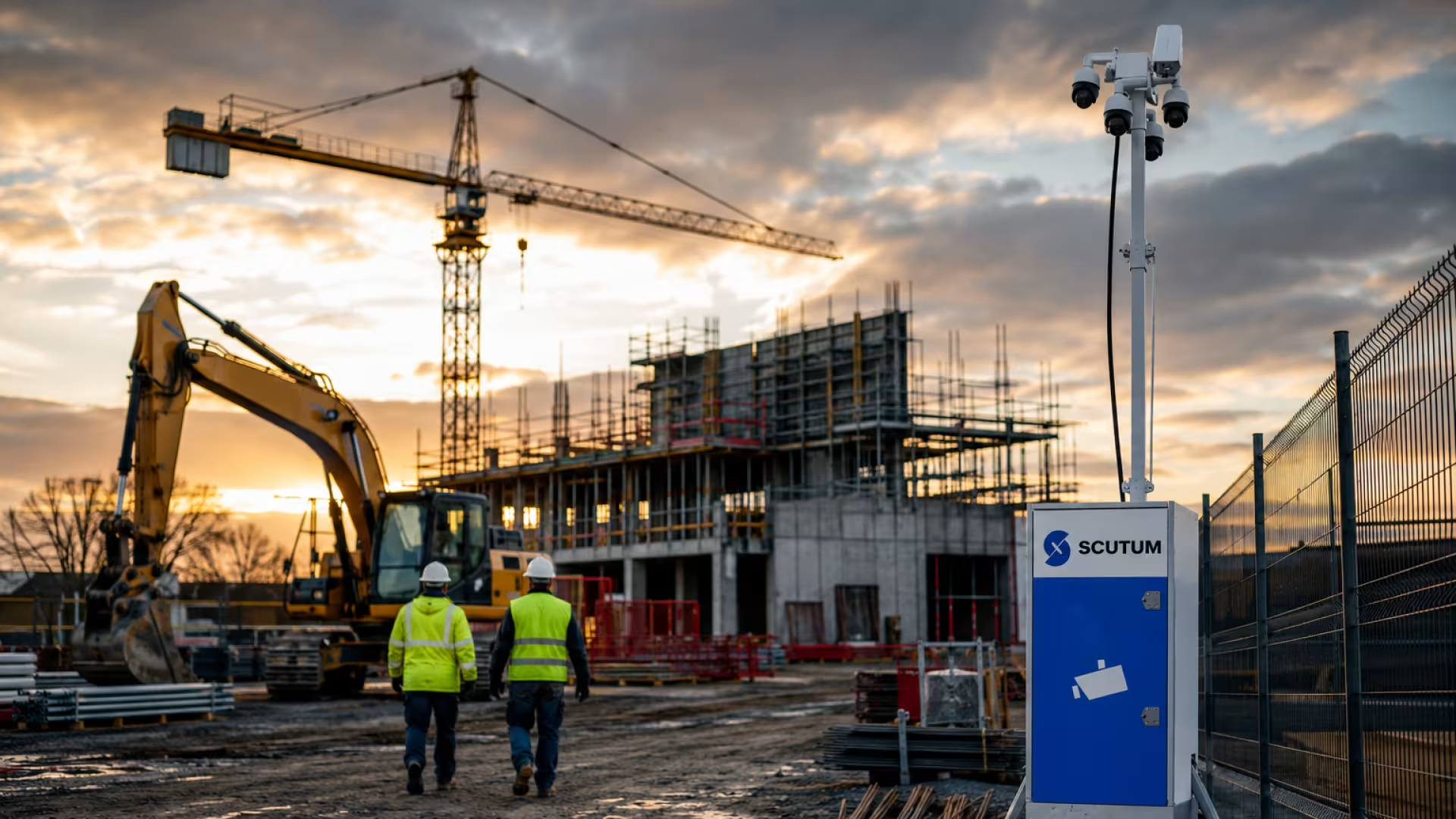
These solutions include mobile monitoring systems that can be deployed rapidly without heavy infrastructure, as well as real-time analysis systems and continuous remote monitoring.

Beyond protection, these approaches provide operational visibility across construction sites and strengthen their management.

By integrating security, data and services, they address the sector’s new challenges: protecting assets, ensuring business continuity and supporting the transformation of on-site practices.

Icon personne

“In construction environments that are inherently constantly changing and fragmented, security can no longer rely on static or isolated systems. It must form part of a comprehensive approach incorporating mobile solutions, real-time monitoring and continuous data analysis. At Scutum, our experience in electronic security and construction environments enables us to design solutions adapted to these constraints: flexible, interoperable and focused on operational management. The challenge is no longer simply to prevent incidents, but to ensure operational continuity and provide construction stakeholders with reliable decision-making visibility under all circumstances.”


Eric Wolf, Technical Manager at Scutum

With nearly 20 years of expertise in electronic security and remote monitoring, Scutum has established itself as a trusted partner for construction companies and operators of sensitive sites. Today, the group supports numerous major companies and industrial leaders that trust Scutum to secure their operations in complex and demanding environments. This hands-on experience, combined with a continuous capacity for innovation, enables Scutum to offer reliable, scalable solutions perfectly suited to the current challenges faced by construction and remote sites.

The keys to effective construction site security

To reduce these risks, certain best practices remain essential. Effective construction site security relies on a comprehensive approach incorporating:

  • anticipating risks from the project stage
  • access control and flow management
  • protecting sensitive equipment
  • implementing continuous monitoring
  • equipment and material traceability
  • raising awareness among on-site teams

These fundamentals provide an essential foundation. However, in constantly changing environments, they now need to be reinforced by more flexible and intelligent solutions.

Need to secure your construction sites?

Discover how Scutum solutions can help you:

  • reduce theft and intrusion
  • secure your equipment
  • improve project management

Contact our experts for a demonstration or a personalised security assessment.