Submitted by Justine.Pource… on
Chantiers isolés.png
published on 13/08/2026

Construction Site Security Against Theft, Intrusion and Vandalism

Written by Eric Wolf

Long considered a secondary concern, construction site security has now become a major strategic issue for players in the construction industry. In an environment marked by increasingly complex projects, a growing number of stakeholders and rising risks, failing to effectively secure sites is no longer an option. It poses a direct risk to project performance, profitability and successful completion.

The UK construction industry plays a vital role in the economy, supporting infrastructure development, housing and commercial projects across the country.

However, construction sites present significant security challenges. As projects become larger and more complex, involving multiple contractors, suppliers and subcontractors, protecting people, equipment and materials becomes increasingly important.

Construction sites often contain high-value machinery, tools and building materials, making them attractive targets for theft, trespassing and vandalism. Remote locations, temporary site boundaries and changing access arrangements can create additional security vulnerabilities.

Against this backdrop, construction site security is about more than preventing unauthorised access. Effective security measures help protect valuable assets, minimise disruption, reduce financial losses and keep projects running safely and efficiently.


Construction Sites: An Increasingly Vulnerable Environment

The construction industry faces ongoing challenges, from increasingly complex projects and tight deadlines to rising costs and operational pressures.

By their nature, construction sites can be difficult to secure. Temporary boundaries, changing layouts and the constant movement of workers, contractors and deliveries create security challenges that differ from those of permanent premises.

Whether a site involves a major infrastructure project, commercial development or remote construction work, several common vulnerabilities can increase the risk of theft, trespassing and vandalism:

  • Multiple access points that can be difficult to monitor and control.
  • Limited security outside working hours, particularly overnight, at weekends and during site closures.
  • High-value machinery, tools and building materials that may be left on site for extended periods.

These vulnerabilities can make construction sites attractive targets for criminal activity, highlighting the importance of effective, adaptable construction site security measures throughout every stage of a project.

Theft, trespassing and vandalism are ongoing security concerns for construction businesses, with consequences that extend far beyond the immediate loss of equipment or materials.

Security incidents can lead to work stoppages, project delays and increased costs, disrupting day-to-day operations and putting additional pressure on contractors and site managers.

Delays may also affect contractual commitments, potentially resulting in financial penalties and reducing overall project profitability.

Even a single incident can have a significant impact on a construction schedule. Replacing stolen equipment, repairing damage or rearranging work can cause further delays, particularly when multiple contractors and project stages depend on one another.

Effective construction site security is therefore not simply about protecting physical assets. It plays an important role in maintaining project schedules, controlling costs and ensuring work can continue with minimal disruption.

Icon personne

“Faced with growing risks, construction site security can no longer be treated as a secondary concern. It must be considered from the project design stage, based on solid fundamentals – risk anticipation, access control, equipment protection, continuous monitoring, traceability and team awareness – while evolving to adapt to increasingly dynamic environments.”


Eric Wolf, Technical Manager at Scutum

Rethinking Construction Site Security from the Planning Stage

The Limitations of Traditional Security Measures

Traditionally, construction site security has relied on manned guarding and fixed security systems. While both approaches remain valuable, they may not always provide the flexibility and coverage required on modern construction sites.

Manned guarding can be expensive, particularly on large sites or where round-the-clock protection is needed. Maintaining consistent coverage across multiple access points and extensive working areas can also be challenging.

Fixed security systems, meanwhile, may be less suited to construction environments where site layouts, access routes and security requirements change as work progresses. Installation can also be time-consuming, particularly where permanent power supplies or communications infrastructure are not yet available.

Without effective real-time monitoring, identifying suspicious activity and coordinating a rapid response can become more difficult, increasing the risk of theft, damage and disruption.

These challenges highlight the need for flexible, scalable construction site security solutions that can adapt as projects develop and provide reliable protection throughout each stage of construction.

Towards Smarter, More Flexible Construction Site Security

Advances in security technology are making it easier to protect construction sites with solutions that adapt to changing layouts, working conditions and security risks.

Modern construction site security solutions combine advanced technology with flexible deployment and effective monitoring to provide reliable protection throughout each stage of a project.

The most effective approaches are built around three key principles:

1 Mobility

Mobility Rapidly deployable security systems can be easily repositioned as construction progresses, allowing businesses to protect vulnerable areas without the need for extensive permanent infrastructure.

2 Intelligence

Real-time video analytics and intelligent threat detection help identify suspicious activity, enabling security teams to assess potential intrusions quickly and coordinate an appropriate response.

3 Continuity

Continuous security monitoring, supported by rapid response procedures, helps identify and address threats quickly, reducing the risk of theft, vandalism and disruption to construction projects.

This combination makes it possible to move from a reactive to a proactive approach to construction site security.

How Site Security can Improve Operational Efficiency

The role of construction site monitoring is evolving beyond simply protecting equipment, materials and premises.

Modern security and surveillance systems can provide greater visibility of site activity, helping construction managers oversee operations and make more informed decisions.

Depending on the technology deployed, these systems can help to:

  • Monitor project progress through remote access to site footage.
  • Improve team coordination by providing better visibility of activity across different areas.
  • Reduce unnecessary site visits by allowing managers to check conditions remotely.
  • Support faster decision-making with access to real-time information.

Recorded footage can also provide valuable evidence in the event of an incident or contractual dispute, helping organisations establish what happened and when.

By combining site protection with operational oversight, modern construction site security solutions can contribute to more efficient project management, reduced disruption and better control of costs.

Data Protection, Compliance and Trust

As construction sites increasingly adopt CCTV and remote monitoring technology, data protection and regulatory compliance are important considerations.

In the UK, the UK General Data Protection Regulation (UK GDPR) and the Data Protection Act 2018 set out requirements for collecting, storing and processing personal data, including identifiable CCTV footage.

Construction site monitoring systems should incorporate appropriate safeguards, such as secure data storage, controlled access, clear retention policies and transparency about how footage is collected and used. Where appropriate, measures such as anonymisation can provide additional protection.

Beyond meeting legal obligations, responsible use of surveillance technology helps build trust among employees, contractors and other stakeholders, ensuring that security measures protect the site while respecting individual privacy.

Case Study: Protecting Construction Sites Against Theft and Vandalism

The benefits of mobile construction site security can be seen in real-world applications.

One example is Schnorpfeil, a German infrastructure company, which introduced mobile surveillance solutions to address recurring theft and vandalism across its construction sites.

By implementing security systems designed to meet the changing demands of its projects, the company reported:

  • Savings of several hundred thousand euros through reduced losses and associated costs.
  • 10–15 intrusions intercepted annually, helping prevent theft and unauthorised access.
  • Fewer disruptions to construction activity, supporting project continuity and productivity.

Beyond the financial benefits, Schnorpfeil also reported greater operational confidence, with teams able to focus on delivering projects knowing that their sites were being monitored.

The case demonstrates how flexible, remotely monitored construction site security can help protect valuable assets while supporting more efficient site operations.

Icon person.png

Construction Site Manager, Schnorpfeil

“Once the employees have left the site, the system is configured. We are very satisfied with the alarm system and it works very well with our employees.

Our workers on the construction site can reconfigure a camera themselves. It is part of their job and it is very easy. They say: ‘Today we are going to put something in this location. So I will monitor this particular area.’

Every year, we intercept around ten intruders thanks to the services deployed. The monitoring system works reliably and effectively. I would recommend this solution without hesitation.”

Expert insight

“Vehicles, machinery or even small tools… anything can become a target on a construction site. Even when the quantities involved appear limited, the impact is far from insignificant. In addition to the immediate additional costs, theft and vandalism often cause delays, which can even lead to contractual penalties.

On projects that are already complex to manage, this creates additional and unnecessary pressure. That is why construction site security is now becoming a strategic priority for construction companies, property developers and operators of remote sites.

It must be considered from the project launch phase and fully integrated into the overall project to ensure effective protection from day one.”


Eric Wolf, Technical Manager at Scutum

The Future of Construction Site Security

How smarter security solutions are helping construction businesses protect assets, reduce disruption and improve operational efficiency.

The security of construction sites and remote locations is evolving beyond traditional surveillance and asset protection.

With theft, vandalism and unauthorised access presenting ongoing challenges, construction businesses are increasingly recognising the value of integrated security solutions that combine intelligent monitoring, early threat detection and rapid response capabilities.

By incorporating security into wider project planning and site management, businesses can reduce financial losses, minimise disruption and maintain greater control over their operations.

Ultimately, effective construction site security is more than a protective measure. It is an investment in operational resilience, helping businesses safeguard valuable equipment, maintain productivity and keep projects on track.

Scutum's Integrated Approach to Construction Site Security

Scutum provides integrated construction site security solutions that combine surveillance technology, remote monitoring and specialist security services.

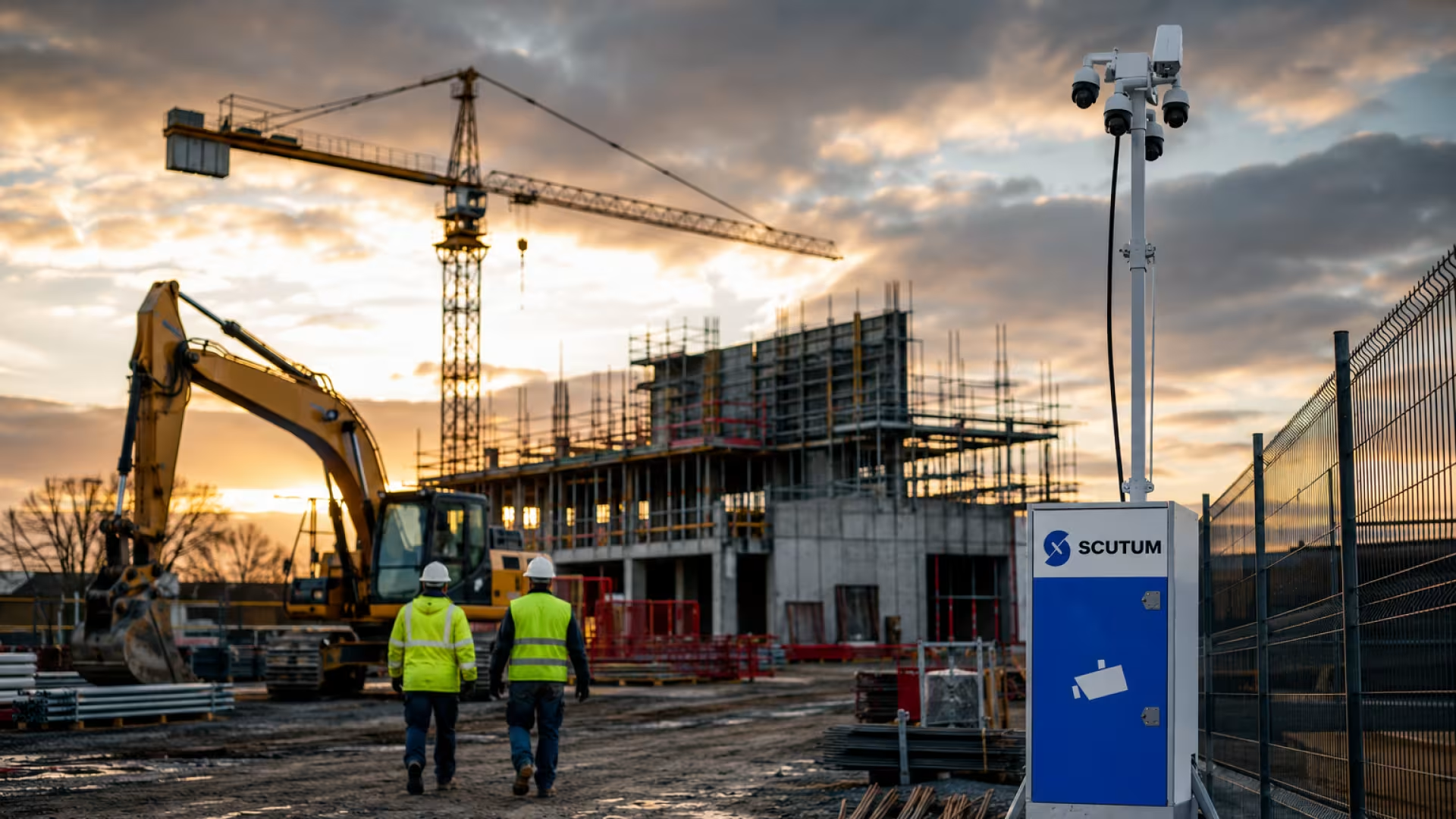
Our solutions include rapidly deployable mobile surveillance systems that help protect construction sites without the need for extensive permanent infrastructure. Depending on site requirements, these can be supported by video analytics and remote monitoring to detect suspicious activity and support an appropriate response.

Beyond protecting valuable equipment, materials and machinery, remote monitoring can provide greater visibility of site activity, helping construction businesses manage security risks and minimise disruption.

By bringing together technology, monitoring and specialist expertise, Scutum helps construction businesses protect their assets and support project continuity at every stage of construction.

Icon personne

“In construction environments that are inherently constantly changing and fragmented, security can no longer rely on static or isolated systems. It must form part of a comprehensive approach incorporating mobile solutions, real-time monitoring and continuous data analysis. At Scutum, our experience in electronic security and construction environments enables us to design solutions adapted to these constraints: flexible, interoperable and focused on operational management. The challenge is no longer simply to prevent incidents, but to ensure operational continuity and provide construction stakeholders with reliable decision-making visibility under all circumstances.”


Eric Wolf, Technical Manager at Scutum

With nearly 20 years of experience in electronic security and remote monitoring, Scutum has developed extensive expertise in protecting construction sites and other challenging environments.

The Group works with businesses across a range of sectors, providing security solutions tailored to their operational requirements.

Combining practical experience with evolving security technology, Scutum delivers flexible, scalable solutions designed to address the changing challenges of construction site and remote site security.

Key Measures for Effective Construction Site Security

Reducing security risks on construction sites requires a coordinated approach that considers the changing nature of each project.

Key measures include:

  • Assessing security risks during the planning stages
  • Managing site access and monitoring vehicle and personnel movements
  • Securing valuable equipment, machinery and materials
  • Implementing appropriate surveillance and monitoring arrangements
  • Maintaining accurate records of equipment and materials
  • Raising security awareness among site personnel

While these measures provide a strong foundation, construction sites are constantly evolving. Flexible security solutions that can adapt to changing site layouts, activities and risk levels can provide additional protection throughout the project.

Need to secure your construction sites?

Discover how Scutum solutions can help you:

  • reduce theft and intrusion
  • secure your equipment
  • improve project management

➝ Contact our experts for a demonstration or a personalised security assessment.