Submitted by Justine.Pource… on
extincteurs
published on 18/08/2026

Fire Safety in the Workplace: A Complete Guide to Regulatory Compliance

Written by Guillaume Brizot – Fire Protection Sales Director

Every year, fires affect thousands of businesses and workplaces across the UK. Behind these figures are potentially serious consequences: injuries and fatalities, destruction of premises and equipment, business interruption and significant financial losses. And yet, in many cases, a fire could have been prevented or brought under control if the appropriate prevention measures had been correctly implemented.

This guide is intended for you, whether you are a small or medium-sized business owner, an HSE manager, a facilities manager or responsible for workplace safety. Its aim is to give you a clear overview of your main fire safety responsibilities, the essential equipment you need and the organisation you should put in place to effectively protect your employees, assets and business.

Fire safety in the workplace is not simply about ticking regulatory compliance boxes. It is a strategic challenge with three key dimensions.

Human risk: the absolute priority

A fire in an open-plan office, warehouse or workshop can become life-threatening within minutes. Toxic smoke can cause casualties long before flames reach certain areas. During a fire, poor evacuation procedures, obstructed escape routes or a smoke ventilation system that fails to operate correctly can considerably worsen the consequences of the incident.

This is a scenario that can occur more often than we think. That is why prevention and preparedness should be part of the day-to-day management of every business.

Material and financial risk: beyond the flames

Destruction of premises, stock and digital data, production downtime, loss of customers... The financial consequences of a fire can be considerable. And insurance does not necessarily cover every loss.

Without a business continuity plan, a company can quickly face serious financial difficulties, particularly when business interruption lasts for several weeks.

Legal and reputational risk

Failure to meet fire safety responsibilities can expose a business and those responsible for its premises to civil, regulatory and potentially criminal consequences, depending on the circumstances and the applicable legislation.

Beyond potential penalties, a company's reputation can also suffer lasting damage. A serious fire can undermine the trust of customers, suppliers, employees and business partners, particularly when shortcomings in fire safety management are brought to light.

The regulatory framework: what are your responsibilities?

In the UK, fire safety requirements depend on the location and type of premises. In England and Wales, the principal framework for most non-domestic premises is the Regulatory Reform (Fire Safety) Order 2005. Scotland and Northern Ireland have their own fire safety legislation.

For a UK-wide business, it is therefore important to check the requirements applicable in the relevant nation.

The Responsible Person: the foundation of fire safety management

Under the Regulatory Reform (Fire Safety) Order 2005 in England and Wales, the person responsible for fire safety is known as the Responsible Person. This may be an employer, owner, landlord, occupier or another person who has control of the premises.

The Responsible Person must carry out and regularly review a fire risk assessment, identify the measures needed to prevent fire and keep people safe, and ensure that appropriate fire safety measures are implemented and maintained.

Three key areas underpin these responsibilities:

  • Fire risk assessment: identify fire hazards, people at risk and the measures required to eliminate or reduce those risks.
  • The implementation of appropriate fire prevention and protection measures: fire alarms, extinguishers, emergency lighting, signage, evacuation procedures and training.
  • Ongoing monitoring and record keeping, including relevant inspections, maintenance, training and fire drills.
Icon personne

Scutum expert advice: Guillaume – Sales Director

Too many businesses carry out a fire risk assessment once and then leave the document forgotten in a drawer. However, a fire risk assessment should be reviewed regularly and whenever significant changes occur.

A risk assessment that no longer reflects the reality of the workplace can leave important hazards unidentified, particularly following a relocation, refurbishment, change of layout or introduction of a new process.

Specific requirements: workplaces, high-risk premises and complex buildings

In addition to general fire safety legislation, additional requirements may apply depending on the nature of the premises and the activities carried out.

1 Offices, shops and commercial premises

The fire safety arrangements must be appropriate to the size, layout, occupancy and activities of the premises. Particular attention should be paid to escape routes, fire detection and warning systems, emergency lighting and firefighting equipment.

2 Industrial premises and warehouses

Industrial sites and warehouses can present additional risks due to machinery, combustible materials, flammable substances, storage arrangements and complex building layouts. The fire risk assessment should take these specific hazards into account.

3 High-risk or specialised premises

Additional requirements may apply to premises such as care homes, hospitals, residential buildings, hotels, licensed premises and other higher-risk environments. The Responsible Person should ensure that the fire risk assessment reflects the specific characteristics of the premises and the people who may be exposed to risk.

In practice, many businesses do not fully understand which requirements apply to their premises, particularly after refurbishment, an extension or a change of activity.

It is therefore important to check the applicable requirements with the local fire and rescue authority or other relevant competent authorities.

Prevention measures and essential equipment

Having the right equipment is not enough. Equipment must also be suitable for the risks present, correctly installed, accessible and regularly tested and maintained.

These are some of the main technical pillars of workplace fire safety.

Fire detection and warning systems: the first line of defence

A fire detection and warning system is one of the first lines of defence. Its purpose is to detect a fire as early as possible and warn people before the situation escalates.

The type of system required depends on the premises, occupancy, layout and fire risk identified during the fire risk assessment.

The main components may include:

  • Automatic fire detectors, which identify signs of fire and trigger an alarm.
  • Manual call points, allowing occupants to raise the alarm manually.
  • Fire alarm control panels, which receive and process signals from the various devices.
  • Audible and visual alarm devices, designed to alert occupants and facilitate a rapid and orderly evacuation.

One area that is often overlooked is maintenance. A dirty detector, a flat battery or a cable disconnected during building work can compromise the operation of the entire system.

Businesses must carry out regular checks to ensure that fire alarm systems are working correctly and that faults are identified and recorded.

Fire extinguishers: acting quickly and correctly

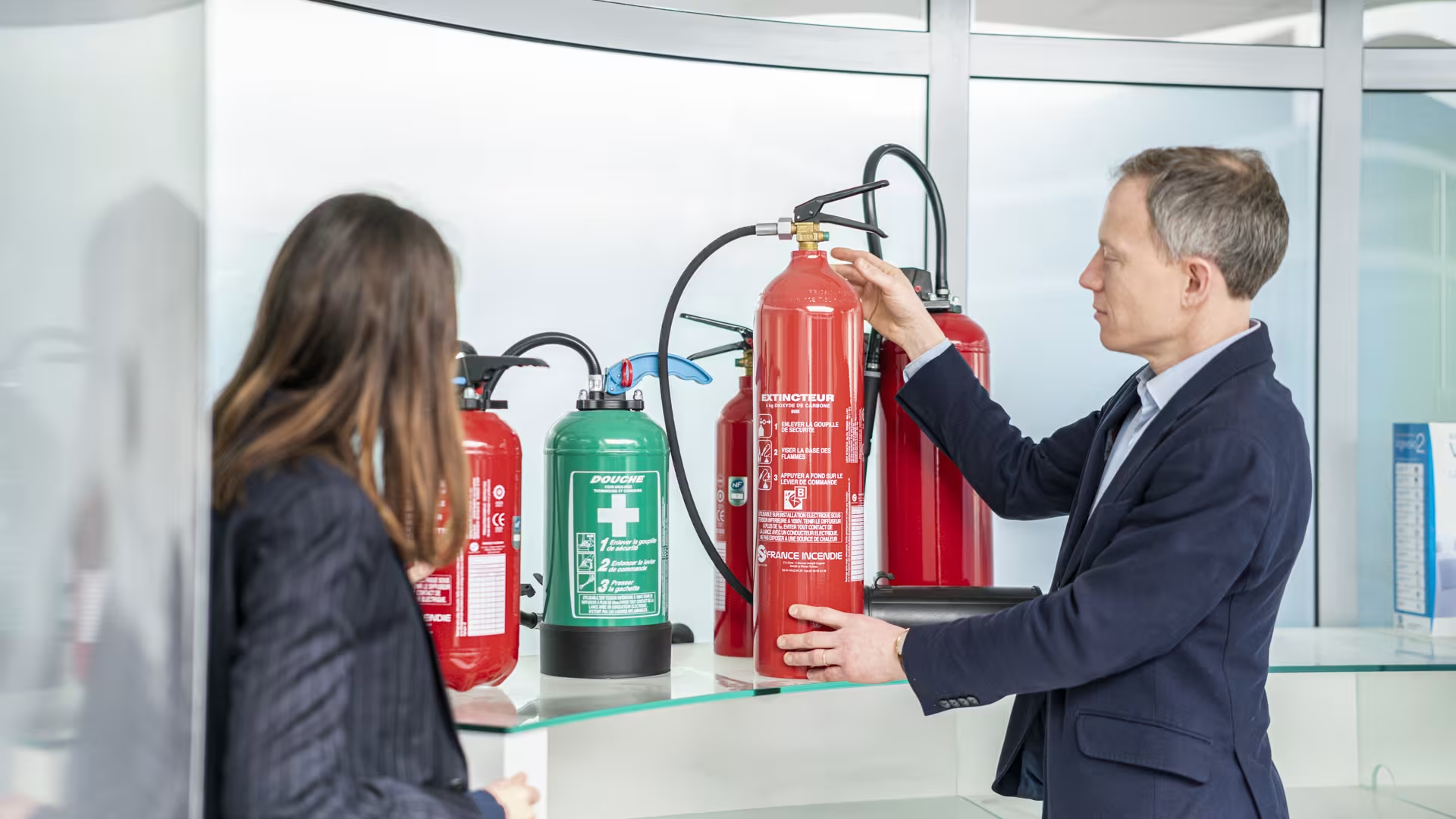
Fire extinguishers remain an important means of first response to a fire.

There is no universal UK rule equivalent to the French requirement of “one extinguisher per 200 m²”. The type, number and positioning of extinguishers should be determined according to the fire risks identified in the premises and applicable standards and guidance.

The main types of fire extinguishers include:

  • Water extinguishers: generally suitable for Class A fires involving materials such as wood, paper and textiles.
  • Foam extinguishers: suitable for certain Class A and Class B fire risks, depending on the specific extinguisher.
  • Dry powder extinguishers: suitable for a range of fire risks, but their use can reduce visibility and may damage sensitive equipment.
  • CO₂ extinguishers: particularly suitable for certain fires involving electrical equipment. They leave no residue after use.

Every fire extinguisher must be visible, accessible and correctly signposted. Fire safety equipment must be properly installed, tested and maintained.

Icon personne

Scutum expert advice – Bruno, technician in Lyon

During our audits, we regularly find fire extinguishers hidden behind furniture, installed at an inappropriate height or with the safety pin blocked by dust.

An inaccessible fire extinguisher is a useless fire extinguisher. Physically check access to every piece of equipment regularly and make sure that no obstacle prevents it from being used quickly in an emergency.

Smoke control and ventilation: supporting safe evacuation

Smoke is one of the main hazards during a fire. Smoke control systems are designed to limit smoke accumulation, maintain tenable escape conditions and support the work of the emergency services.

Depending on the building and its fire strategy, different solutions may be used, including:

  • Natural smoke ventilation, using smoke vents and openings.
  • Mechanical smoke ventilation, using powered extraction systems.

The maintenance of these systems is essential. Problems can include vents blocked by corrosion, faulty actuators or smoke outlets obstructed by installations added over time.

These are silent failures that may go unnoticed until the system is actually required to operate.

Evacuation organisation: the key to saving lives

Equipment is of little value without rigorous organisation. The human factor can make the difference between an orderly evacuation and a panic situation.

Evacuation plans and fire safety instructions

The fire evacuation plan should clearly show the escape routes, emergency exits and relevant fire safety equipment.

A suitable emergency plan should address:

  • Escape routes and emergency exits.
  • The location of fire extinguishers, manual call points and other fire safety equipment.
  • Assembly points.
  • Procedures to follow in the event of a fire.

Fire safety and evacuation plans should ensure that escape routes are clear, appropriately marked and as short and direct as possible. Emergency doors should open easily and emergency lighting should be provided where required.

Fire safety instructions should be clear, simple and tailored to the premises. Avoid generic documents downloaded from the internet if they do not reflect the reality of your workplace.

Signage: providing guidance even in a panic

When smoke fills a corridor, appropriate signage helps people quickly identify escape routes and exits.

Emergency lighting and illuminated or photoluminescent signs help mark escape routes and identify emergency exits and firefighting equipment.

All escape routes and fire exits should remain clearly identifiable and accessible. Fire exit signs should be correctly positioned and maintained.

Icon personne

Scutum expert advice – Jean-Charles, trainer

“During an evacuation training session for a transport company, 40% of the staff did not know where the emergency exits were located.

As a result, the evacuation took too long and employees used the same emergency exit, even though there were five exits available in the facility.

Congestion occurred and evacuation time doubled. Signage is not enough if people are not trained to understand it.”

Staff training: putting the human factor at the heart of the system

Even the best fire protection installation in the world will be ineffective if nobody knows how to respond. Fire safety training is a fundamental part of prevention and emergency preparedness.

pme icon

Les formations obligatoires : deux volets sont incontournables :

La manipulation des extincteurs : chaque collaborateur doit savoir utiliser un extincteur. En pratique, une formation théorique seule ne suffit pas. Privilégiez les sessions avec mise en situation réelle (feu écologique) pour ancrer les réflexes.


Les consignes d’évacuation : l’ensemble du personnel doit connaître les itinéraires d’évacuation, l’emplacement du point de rassemblement et le rôle des guides et serre-files.

People with specific needs must also be taken into account: employees with disabilities, visitors, temporary workers, contractors and subcontractors. Their evacuation should be incorporated into the emergency arrangements.

Fire drills

Businesses should carry out regular fire drills appropriate to the risks and characteristics of their premises. UK government guidance recommends carrying out at least one fire drill per year and recording the results as part of the fire safety and evacuation arrangements.

A drill is not simply a formality: it allows the actual effectiveness of the organisation to be tested.

A properly conducted exercise can:

  • Create automatic responses among occupants.
  • Identify bottlenecks (blocked doors, obstructed stairways, inadequate signage).
  • Check the operation of alarm and smoke control systems.
  • Measure evacuation time and compare it with established objectives.

Vary the scenarios — a fire in a technical room, a car park or during the lunch break — to avoid creating a routine. An exercise that is always identical eventually stops testing the organisation's real response capabilities.

Fire safety records: demonstrating compliance

Fire safety documentation and records are essential for demonstrating that appropriate measures are in place and being maintained.

Depending on the premises and applicable requirements, records should include:

  • Dates and results of inspections and maintenance of fire safety equipment.
  • Fire drill reports, including evacuation times and observations.
  • Records of staff fire safety training.
  • Reports and certificates from competent contractors and inspection bodies where applicable.
  • The current fire risk assessment and evidence of reviews.

The Responsible Person must keep a written record of the fire risk assessment and review it regularly.

In the event of a fire, incomplete documentation can make it more difficult to demonstrate that appropriate fire safety measures were implemented and maintained.

This is not simply an administrative file: it is an essential part of effective fire safety management.

Icon personne

Scutum expert advice – Guillaume, Sales Director

“Digitise your fire safety documentation. A paper file lost in a cupboard may be of little use on the day you actually need it.

Digital solutions make it possible to schedule automatic reminders for inspections, access the history of actions immediately and facilitate information sharing with suppliers and insurers.”

Conclusion: fire safety is more than an obligation – it is part of your company culture

Protecting a business against fire risk relies on four inseparable pillars: rigorous risk assessment, appropriate and properly maintained equipment, a tested evacuation organisation and trained and engaged employees. None of these pillars works in isolation.

Regulatory compliance is not a destination; it is an ongoing process. The most resilient businesses are those that take a proactive approach to fire safety, integrating prevention into their day-to-day operations rather than reacting after an incident or inspection.

Would you like to review the level of compliance of your premises? Scutum experts carry out comprehensive fire safety audits and support you in assessing and improving your fire safety arrangements, from the initial assessment through to equipment maintenance.

Contact us to discuss your situation and develop an action plan tailored to your needs.