
Submitted by editor on
Géolocalisation indoor pour travailleuse isolée dans une zone industrielle sans signal GPS.
published on 06/01/2026

Indoor Location Tracking: Protecting Lone Workers

In an emergency involving a lone worker, being able to determine their precise location is critical. In large buildings, underground car parks, industrial facilities or logistics warehouses, traditional GPS technology may be insufficient, making it essential to implement an appropriate indoor location solution to ensure assistance can be provided quickly and effectively.

Indoor Location Tracking for Lone Workers

Indoor location tracking helps protect lone workers in environments where GPS signals may be weak or unavailable. While GPS can provide accurate location information outdoors, its effectiveness is often reduced inside buildings, particularly in large industrial facilities, warehouses, basements and multi-storey premises.

Indoor positioning technology helps overcome these limitations by enabling employers and emergency responders to identify a lone worker's location within a building. Depending on the system, this may include identifying the floor, zone or specific area where an employee is working.

If an alert is triggered following a fall, medical emergency, accident or threatening situation, accurate indoor location information can help responders find the employee more quickly and provide appropriate assistance.

This is particularly valuable for maintenance engineers, technicians, security personnel and other lone workers operating across large or complex sites, where colleagues may not be nearby and locating someone in an emergency could otherwise take considerable time.
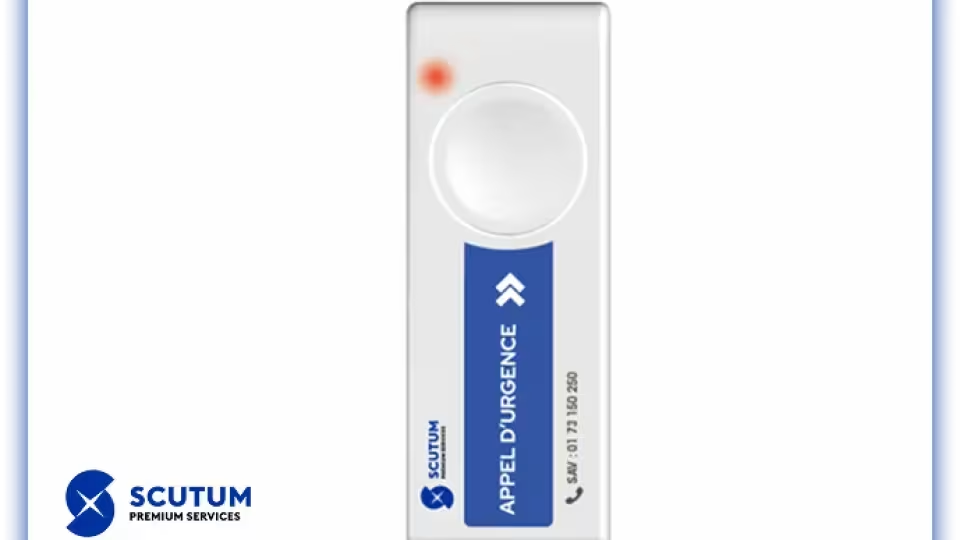
Scutum Indoor Geolocation

To address this challenge, Scutum offers a comprehensive lone worker protection solution that incorporates indoor geolocation technology. Our devices, combined with strategically positioned indoor radio beacons, enable lone workers to be located even in areas where GPS signals are unavailable or unreliable.

The lone worker device automatically detects and records nearby beacons within a defined range. If an alert is triggered, the device transmits the identifiers of the last detected beacons to the remote monitoring centre, allowing operators and emergency responders to accurately determine the employee's location.

This significantly reduces response times and enables assistance to be directed precisely where it is needed, improving safety and ensuring rapid intervention in the event of an incident.

Bouton d’appel d’urgence IOT Scutum Premium Services

What is the SIGFOX Network?

Sigfox is a low-power wireless network designed for the Internet of Things (IoT), allowing connected devices to transmit small amounts of data over long distances while consuming very little energy.

Often referred to as a 0G network, Sigfox provides an alternative to conventional mobile networks such as 4G and 5G for applications that require occasional data transmission rather than high-speed connectivity.

The technology is used in applications such as asset tracking, remote monitoring and connected sensors, where long battery life and reliable transmission of small data messages are important.

Sigfox operates internationally, although network coverage and availability vary by country and location. Organisations considering Sigfox-enabled devices should therefore check coverage in their intended operating areas.

What Is the Internet of Things (IoT)?

The Internet of Things (IoT) refers to a network of connected devices that collect, share and exchange data through the internet or other communication networks.

IoT technology is used across a wide range of industries, including manufacturing, logistics, healthcare, building management and security.

By connecting physical devices to digital systems, IoT enables organisations to monitor equipment, track assets, automate processes and improve operational efficiency. The data collected can also provide valuable insights, helping businesses make more informed decisions and respond quickly to changing conditions.

As connected technology continues to develop, IoT is playing an increasingly important role in creating smarter buildings, safer workplaces and more efficient business operations.