Submitted by Justine.Pource… on
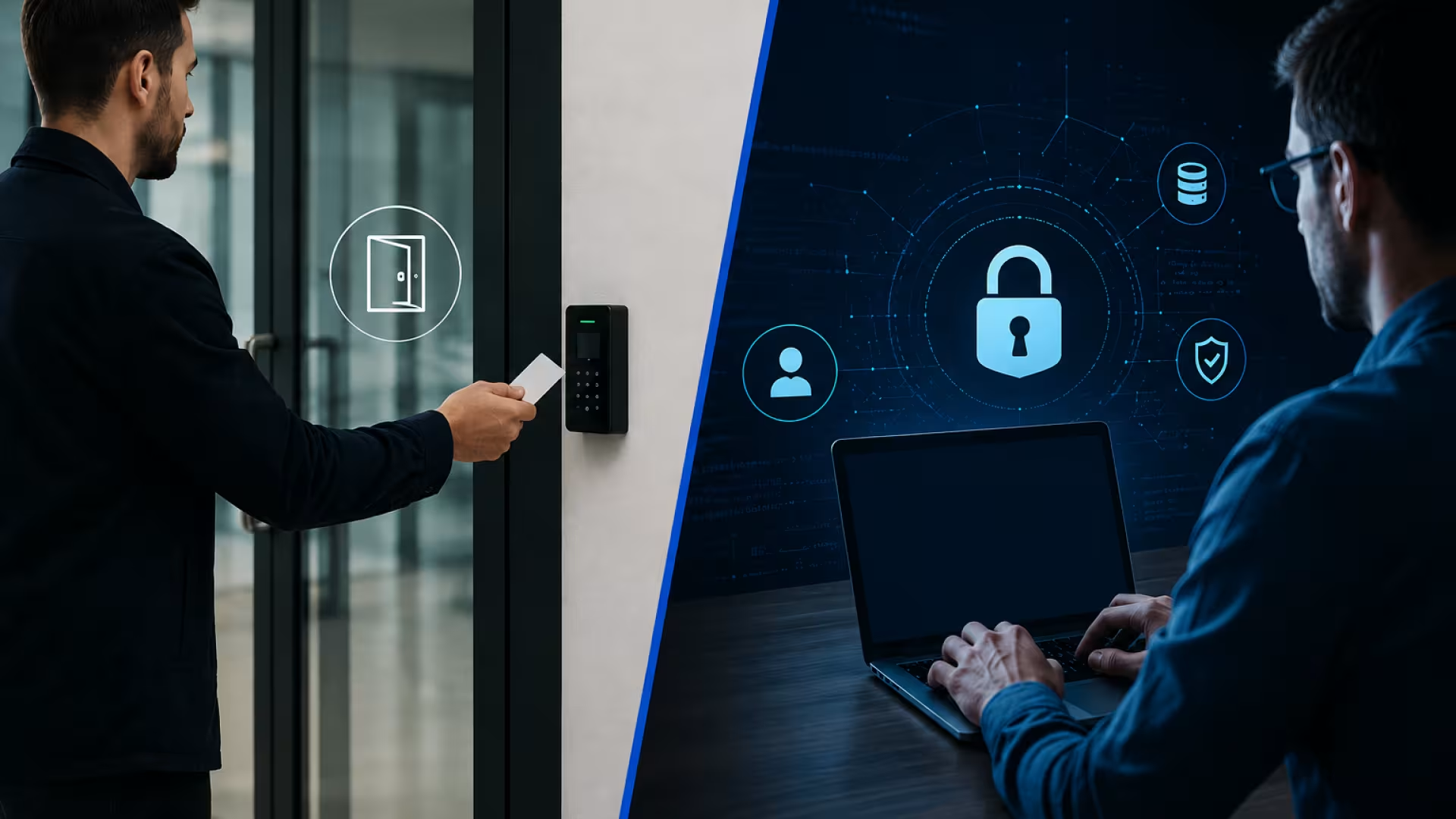
Comparaison entre le contrôle d'accès physique par badge et le contrôle d'accès logique sur ordinateur pour sécuriser les accès en entreprise.
published on 16/09/2026

Physical vs. Logical Access Control: What Are the Differences and How Can They Be Unified?

Written by Nawres CHELBI

A company's security relies on protecting its buildings and its data. But are these two protective barriers really separate?
Many organizations continue to treat physical security (access badges, turnstiles, cameras) and logical security (passwords, firewalls, VPNs) as two separate worlds, managed by two teams that do not communicate with each other.
The result: vulnerabilities appear precisely where these two worlds intersect.
Understanding each approach and making them work together is now essential to any comprehensive security strategy.

What Is Physical Access Control?

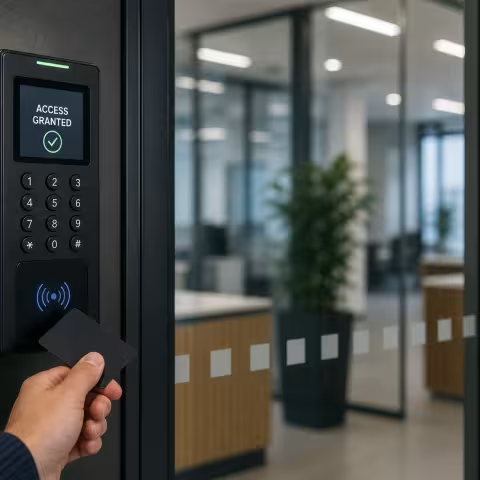
Physical access control involves regulating access to an organization's physical spaces, such as buildings, offices, warehouses, server rooms and parking areas.

Its objective is simple: to protect people (employees, visitors, contractors), physical assets (workstations, machinery, inventory) and sensitive infrastructure, while preventing intrusions, theft and vandalism.
Access Control

In practice, this can take very concrete forms:

  • mechanical and electronic locks;
  • RFID or NFC badges to control entry;
  • turnstiles and security gates;
  • biometrics (fingerprint, facial recognition) for the most sensitive areas;
  • video intercom systems and, depending on the site, the presence of security personnel.

These systems answer a single question: who has the right to be physically present in this place at this specific time?

Pictogramme d'ampoule noir

Good to know

Physical access control is not limited to entrance doors. Organizations can define different authorization levels based on profiles (employees, visitors, contractors), schedules or sensitive areas. For example, an employee may be able to access their office without being allowed to enter a server room or technical area.

What Is Logical Access Control?

Logical access control, or IT access control, aims to restrict access to digital resources such as data, applications, systems and networks.

It pursues a different but equally vital objective: ensuring the confidentiality, integrity and availability of information, which experts refer to as the CIA triad. In practical terms, this means preventing unauthorized access, data breaches and cyberattacks.

GettyImages-2152664008.jpg

The most common technical components include:

  • usernames and passwords;
  • strong or multi-factor authentication (MFA/2FA);
  • detailed management of access rights and permissions (access control lists, or ACLs);
  • virtual private networks (VPNs);
  • digital certificates.

The question here is no longer “who can enter this building?” but rather “who can access, modify or delete this data?”

Pictogramme d'ampoule noir

Good to know

Logical access control is not limited to authentication. Not all users need the same access rights. An employee, contractor or system administrator should not be able to access or modify the same information. Adapting permissions according to user profiles significantly reduces the risks of data breaches or operational errors.

Analysis criterion Physical access control Logical access control
Protection target Locations, physical assets, physical infrastructure and people. Data, applications, networks and information systems.
Nature of threats Intrusion, equipment theft, vandalism, assault, on-site industrial espionage. Hacking, phishing, ransomware, credential theft, malware.
Scope of action The physical world (buildings, server rooms, storage areas, parking areas). The digital world (software, databases, cloud environments, VPNs).
Examples of barriers Security doors, security gates, turnstiles, fences. Firewalls, intrusion detection systems (IDS), antivirus software.
Authentication methods RFID badges, mechanical keys, biometric readers (fingerprint, facial recognition). Passwords, multi-factor authentication (MFA), digital certificates.
Consequence of a vulnerability Property damage, risk to personnel, theft of equipment. Customer data breaches, production downtime, regulatory fines (GDPR).

Complementarity: Why Can't One Work Without the Other?

To better visualize their complementarity, let's look at two scenarios.

Scenario 1. A thief steals an unencrypted laptop left in an unlocked office. The vulnerability is initially physical (a door that was not properly locked), but it immediately leads to a logical vulnerability (access to the company's data).

Intrusion dans un bureau d'entreprise avec un individu non autorisé quittant les lieux avec un ordinateur portable laissé sans surveillance.


Scenario 2. A hacker steals the credentials of a system administrator. From their computer, they remotely disable the video surveillance cameras before a team enters the site. The vulnerability is initially logical (compromised administrator credentials), but it leads to a physical vulnerability (an intrusion into the premises made possible by disabling the video surveillance system).

Cyberattaque compromettant un système informatique et permettant une intrusion physique dans un bâtiment d'entreprise après la désactivation de la vidéosurveillance.


In both cases, a single vulnerability is enough to compromise the entire security system.

Pictogramme utilisateur

Aymeric Tissot-Favre, Manager Cyber by Scutum

A strong password is no longer enough. Today, most attacks exploit compromised or stolen credentials. Combining multi-factor authentication (MFA) with rigorous access rights management has become an essential best practice for limiting risks.

Towards Unified Security: The Convergence of Physical and Logical Security

Convergence means enabling physical and logical security systems to communicate with each other so that they can share information and trigger coordinated actions, rather than operating in silos.

The concrete benefits of such an approach include:

  • 360° visibility: a badge activated to enter the building can be correlated with a network connection, immediately revealing an inconsistency (badge used, but no connection, or vice versa).
  • Automated incident response: a badge reported as stolen immediately blocks the user's associated logical access rights, without waiting for manual intervention.
  • Centralized management: when an employee joins or leaves the organization, all access rights (physical and logical) can be created or revoked in a single operation, rather than through two separate and often unsynchronized processes.
  • Easier investigations: in the event of an incident, cross-referencing physical and logical access logs makes it possible to reconstruct a complete scenario much more quickly than working with two separate sources.

An effective security strategy is no longer about protecting buildings and information systems separately, but about making them work together. This convergence helps reduce risks, improve incident detection and strengthen the company's security over the long term.

Is your security strategy truly comprehensive? Scutum experts can support you in auditing your systems.

équipe Scutum

FAQ: Frequently Asked Questions About Physical and Logical Access Controls

Why can't I rely solely on good physical security?

A secure server room is of little use if administrator passwords are weak: the door is locked, but the digital key is accessible to everyone. Modern threats (phishing, ransomware) completely bypass physical barriers.

With the rise of remote work and cloud services, access to information systems no longer takes place exclusively from company premises. Securing identities and access has therefore become a major concern.

What is the biggest risk of neglecting one of the two?

Neglecting physical access control exposes an organization to equipment theft, industrial espionage and sabotage. Neglecting logical access control can lead to data breaches, information system downtime in the event of ransomware, and identity theft. In both cases, the consequences can be similar: financial losses, reputational damage and non-compliance with GDPR requirements.

How can I start unifying access controls in my small or medium-sized business?

Three steps are enough to get started. First, conduct an audit: identify who has access to what, both physically and digitally. Next, establish a single identity management policy, with single sign-on (SSO) if possible. Finally, prioritize solutions that can interface with each other, such as an access badge system that communicates with Active Directory, rather than two tools that operate independently.