Submitted by Justine.Pource… on
Audit de sécurité.png
published on 11/08/2026

Security Audit: A Strategic Tool for Anticipating Business Risks

Written by Stéphane Couturier

An employee leaves a fire exit ajar; an external contractor moves freely around the premises without a security badge; confidential information is accidentally sent to the wrong address. These situations may seem harmless, yet they can be the starting point for serious incidents.

Is your business truly protected? Do you know where your vulnerabilities lie?

A security audit provides a structured answer to these questions. It is a proactive approach that identifies vulnerabilities before they can be exploited. Not to cause alarm, but to enable you to act with confidence and peace of mind.

What is a security audit and why is it essential?

A health check for your security

A security audit is a methodical assessment process covering all of an organization’s protective measures. It analyzes the measures in place to protect property, people and information against malicious acts.

In a way, it is a health check for your security: a comprehensive assessment that helps determine where your organization is well protected and where it is exposed.


Security vs. safety: a fundamental distinction

These two terms are often confused. However, they refer to two very different realities:

tick icon

Security

protects against intentional acts: intrusion, theft, assault, industrial espionage and sabotage.

tick icon

Safety

protects against unintentional incidents: fire, workplace accidents and equipment failure.

This article focuses on security, and on how an audit can rigorously assess the level of protection in place.

The objective: identify vulnerabilities to address them effectively

A security audit is not about finding people to blame. Its purpose is to provide an objective and impartial assessment of the situation and propose concrete, prioritized actions. The objective is simple: turn identified vulnerabilities into areas for improvement.

Audit de sûreté.png
Icon person.png

Stéphane Couturier, Scutum Sales Director

“Businesses often have a perception of their level of protection that does not fully correspond to the reality on the ground. Our role is precisely to bridge that gap, without judgment, but with clarity. This clarity enables management to make decisions based on facts rather than assumptions.”

The different types of risks analyzed during an audit

Every business has a unique risk profile. A comprehensive security audit covers all potential threats, whether they come from outside or within the organization.

Building

External threats

• Intrusion and theft: unauthorized access to premises, theft of equipment or inventory.

• Vandalism and damage: damage to infrastructure and equipment.

• Industrial espionage: acquisition of strategic data, patents or know-how.

• Assault: physical threats to employees or customers.

Fingerprint

Internal threats

These risks are often underestimated. Yet they can result in significant and long-lasting losses.


• Theft of goods or data by an employee.

• Internal fraud: embezzlement, falsification and abuse of trust.

• Unauthorized access to sensitive areas or information.

• Sabotage or malicious acts by a disgruntled employee.

How a security audit is conducted: a rigorous methodology

A security audit cannot be improvised. It follows a structured four-step process designed to ensure a comprehensive assessment and relevant recommendations.

Audit de sécurité.png

Step 1: Preparation – document analysis

Before even visiting the site, auditors collect and analyze the available information.

They review facility plans and diagrams, current security procedures and the history of reported incidents. The exact scope of the audit is defined in advance during an initial meeting with the relevant stakeholders.

This phase provides a solid foundation and helps focus the on-site investigation.

Step 2: On-site assessment – the fieldwork phase

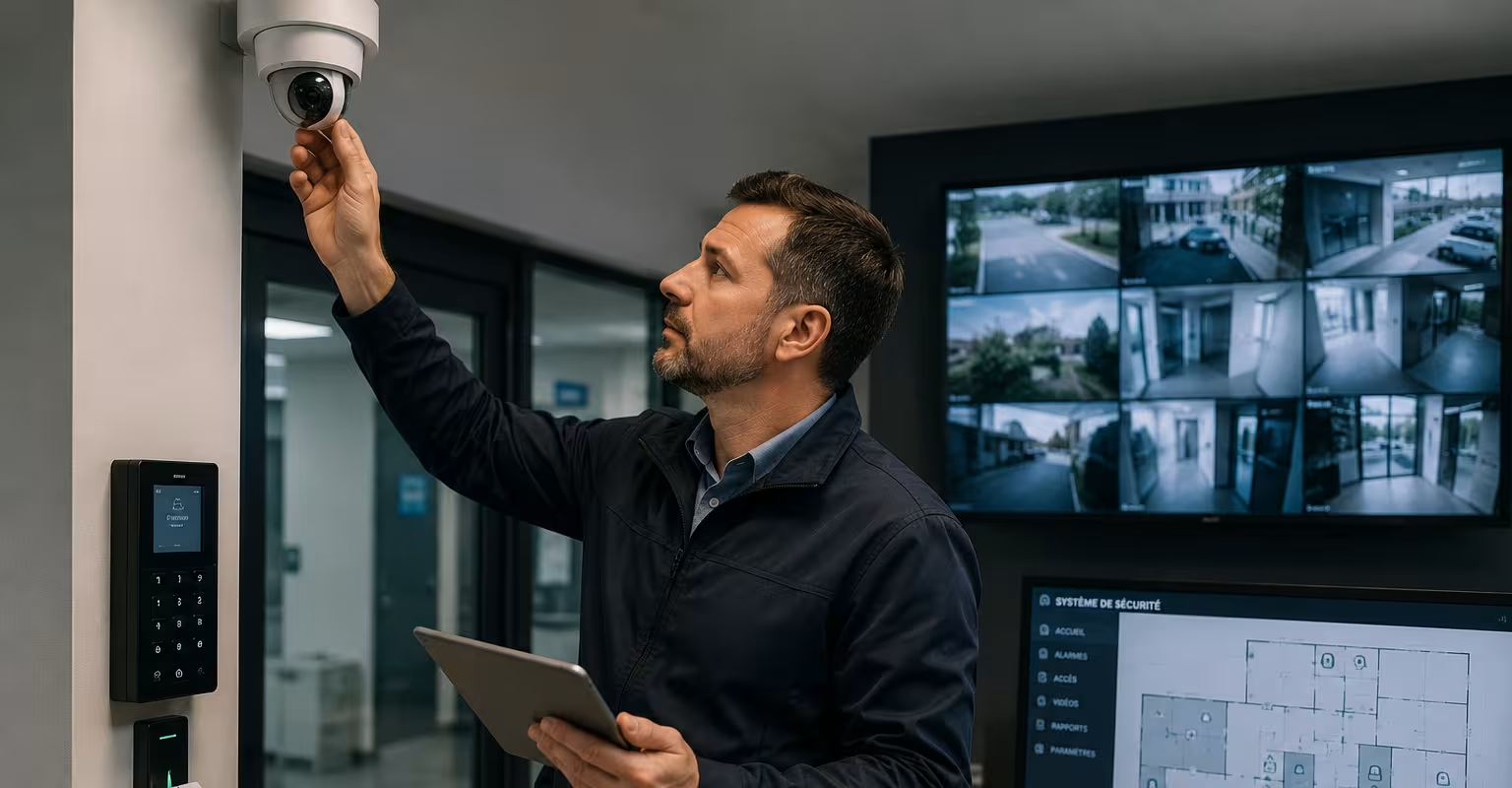
This is the core of the audit. Auditors conduct a comprehensive physical and organizational inspection:

  • Physical protection: fencing, doors, locks, lighting and access areas.
  • Technical systems: video surveillance, access control and alarm systems.
  • Organization and procedures: management of visitors, keys, deliveries and security badges.
  • Interviews with key personnel at different levels of the organization.

Each point is analyzed in light of the company’s specific context: its sector, size and sensitive activities.

Audit de sûreté 2.png

Step 3: Analysis and report preparation

Based on the observations collected, auditors prepare a structured report. It summarizes the strengths and vulnerabilities identified, ranks risks according to their likelihood of occurrence and potential impact, and provides a clear and objective view of the company’s security level.

This document becomes the reference point for all subsequent decisions aimed at strengthening security.

Step 4: Presentation of findings and action plan

The report alone is not enough. The value of the audit becomes tangible when the findings are presented. The results are clearly presented to management, together with a prioritized and costed action plan.

The recommended measures are organized around three complementary areas: people, technology and organization.

CMV04068.jpg

Would you like to learn more about our approach? Contact the Scutum experts for a personalized discussion.

Icon person.png

Stéphane Couturier, Scutum Sales Director

“The presentation of the findings is the moment when the audit really comes to life: we explain the results, set priorities and answer questions. The support that follows is just as important, because implementing recommendations takes time and resources and sometimes requires overcoming internal resistance. Our added value does not stop when the report is delivered.”

Tangible benefits: turning an audit into a competitive advantage

A security audit is not a cost. It is a strategic investment whose benefits can be measured in the short, medium and long term.

1 Protect your assets

First and foremost, it helps protect your assets by reducing financial losses associated with theft, damage or business interruptions.

2 Ensure employee safety

It also contributes to employee safety: a secure work environment strengthens employee well-being, confidence and team productivity.

3 Optimize security spending

From a budgetary perspective, it helps optimize security spending by investing where the actual risks exist, without unnecessary expenditure.

4 Improve your image

It also strengthens the company’s image by demonstrating its professionalism and commitment to customers, partners, insurers and regulatory authorities.

5 Peace of mind

Finally, it provides something that is harder to quantify but just as valuable: peace of mind. Having a clear, documented view of your level of protection means you can make informed decisions without having to improvise.

For the CEO, this means risk control and business continuity. For the Risk Manager, it means cost optimization and compliance. For the Security Manager, it means a concrete action plan and an expert partner at their side. A security audit addresses everyone’s needs.

Femme qui sourit avec ses collègues pendant la formation DATI Connect

Conclusion: make security a pillar of your strategy

Risks do not disappear on their own. They evolve, shift and diversify. Businesses that choose to anticipate risks rather than simply react to them are making a major strategic decision.

A security audit is the tool that makes this anticipation possible. It transforms uncertainty into clarity and vulnerability into an action plan.

Do not leave the level of your protection to chance. Contact the SCUTUM experts for a personalized security assessment and tailored support adapted to your challenges and environment.

FAQ: Frequently Asked Questions About Security Audits

When should a business consider a security audit?

Several situations may justify bringing in an auditor:

  • Following a security incident (theft, intrusion, fraud or attempted espionage) to understand what went wrong and how to prevent it from happening again.
  • During organizational changes: opening a new facility, growing the workforce or undergoing an internal reorganization.
  • As a preventive measure, to identify vulnerabilities before they are exploited.
  • Following a regulatory, insurance or strategic requirement.

Is a security audit suitable for all industries?

Yes. Wherever there are assets, data or people to protect, a security audit can be relevant. It is particularly appropriate for industrial, logistics, commercial or sensitive facilities, but it is equally relevant to SMBs, which are often more exposed to organizational vulnerabilities than larger organizations because they have fewer resources specifically dedicated to security.

In all cases, recommendations are tailored to the industry, size and risk profile of the business. There is no standard solution: every assessment is unique.

How should actions be prioritized after a security audit?

Prioritization is based on two fundamental criteria: the likelihood of occurrence of the risk and its potential impact on business operations.

Urgent actions are those that expose the business to immediate danger. They must be addressed as a priority, regardless of constraints.

Important actions, while not critical, are planned over the medium term, taking budgetary and operational realities into account.

The objective is always to prioritize measures with a high and rapid impact on risk reduction, so that concrete results can be achieved as quickly as possible.

How can the effectiveness of actions implemented after an audit be measured?

Effectiveness can be measured over time using precise indicators:

  • Reduction in the number of recorded security incidents.
  • Monitoring of key indicators: unauthorized access, losses and detected anomalies.
  • Regular follow-up audits to reassess the level of protection.
  • Progressive improvement in the overall level of risk management.