Submitted by Justine.Pource… on
Dispositif d'alarme pour travailleur isolé de Scutum Premium Services
published on 11/08/2026

What is the difference between PTI and DATI?

Written by Nawres Chelbi

In the field of personal safety, and particularly when it comes to protecting isolated workers, the acronyms PTI and DATI are widely used. Although they are often used interchangeably, they actually refer to different but complementary concepts. Understanding the real difference between them is essential to ensure optimal protection and compliance with regulations.

Understanding the difference between PTI and DATI is essential for any HSE manager, HR director or company director: it is the key to providing genuine protection for your teams and ensuring robust compliance with regulations relating to isolated workers.

This guide explains what each concept involves, what the law requires and how to combine the two to create a truly effective protection system.

Understanding PTI (Protection of Isolated Workers)

"Work is considered isolated when the worker is beyond the sight or hearing range of other people, with no possibility of seeking external assistance, and when the work involves a dangerous activity."

— Assurance Maladie


The employer must assess the risks associated with this isolation, define appropriate preventive measures, provide alert mechanisms in the event of danger and organise a rescue chain capable of responding as quickly as possible. PTI (Protection of Isolated Workers) is not a piece of equipment. It is a prevention and organisational approach.

This is not a recommendation, but a legal obligation.

Employer obligations regarding PTI

The legal framework is clear.

Under Articles L. 4121-1 and subsequent articles of the French Labour Code, employers are required to take all necessary measures to ensure the safety of their employees. This involves assessing risks, implementing appropriate measures and documenting them. In the event of an accident involving an isolated worker, the Labour Inspectorate will not simply check whether a device was provided; it will assess the consistency and effectiveness of the overall PTI approach.

The Labour Inspectorate will not ask: "Did you have a DATI?" It will ask: "Did you identify the risk? Was there a procedure in place?"

Who is concerned by PTI?

Any employee who works alone, outside the sight and hearing range of a colleague, is concerned by PTI. This includes maintenance technicians, security officers carrying out patrols, home-care workers, drivers and delivery drivers, field technicians, employees working irregular or night shifts, workers in rural areas and sales representatives travelling for work.

PTI is not limited to construction sites or factories. As soon as an employee works alone and is exposed to a risk without the possibility of receiving rapid assistance, the employer has a legal obligation to implement a PTI approach.

Pictogramme d'ampoule noir

Good to know

Isolated work does not only concern industrial occupations. An employee working alone in a shop, car park or office building can also be considered an isolated worker.


If you are the last person remaining in the office and all your colleagues have already gone home, you are considered an isolated worker.

Understanding DATI (Isolated Worker Alert Device)

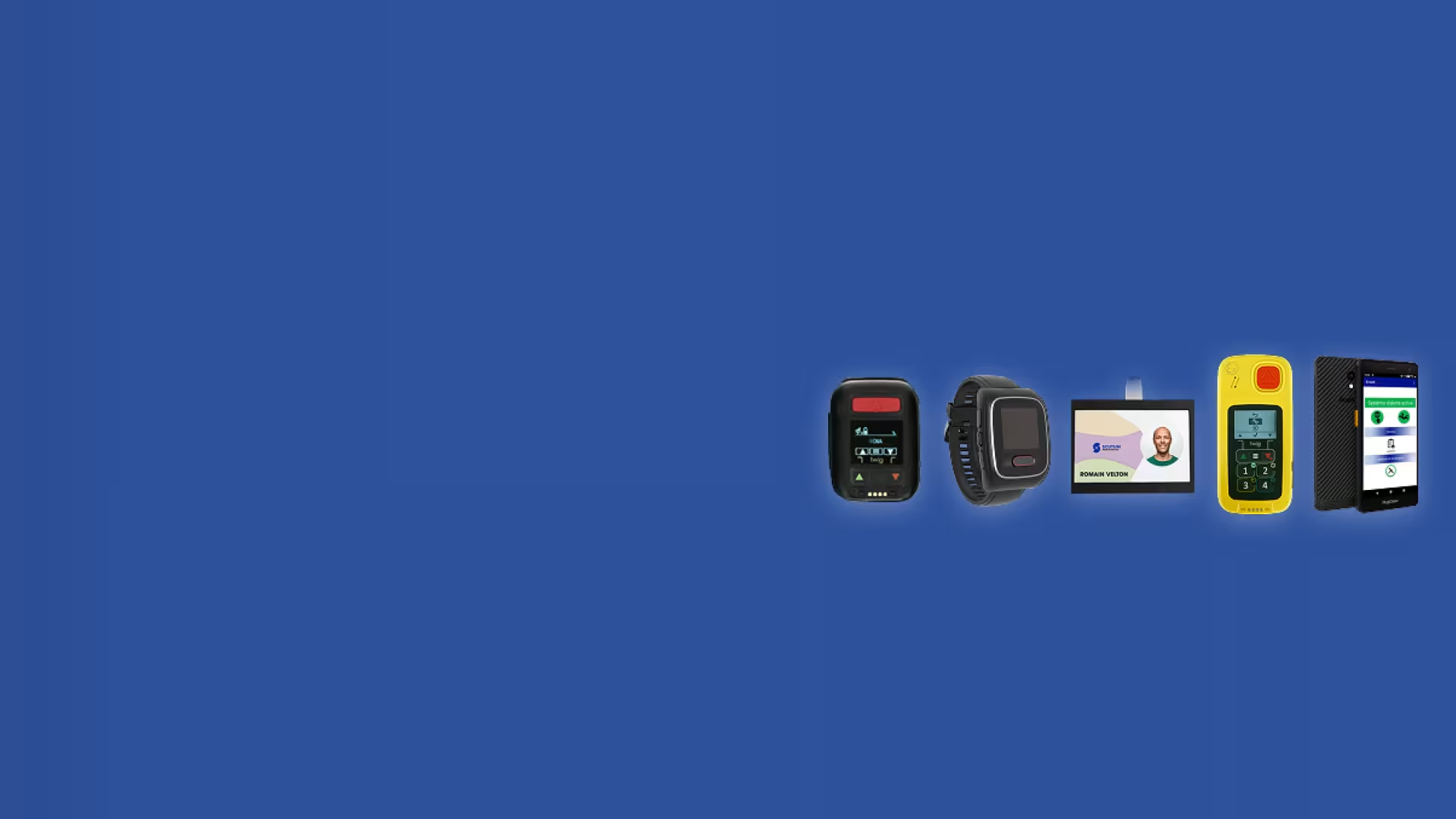
A DATI, or Dispositif d’Alerte pour Travailleur Isolé, is the device (or application) that enables an isolated worker to trigger an alert in the event of an accident, illness, assault or incident. While PTI is an organisational approach, DATI is a tool.

It can take several forms: a safety device, badge holder, smartphone application or connected watch. What defines a DATI is its ability to detect a problem and alert the emergency services.

A DATI operates according to two principles:

  • Manual activation: the employee presses an SOS button.
  • Automatic activation: detection of a fall, prolonged immobility or loss of verticality.

The alert is then transmitted to a remote monitoring centre, an internal supervisor or an intervention chain defined by the company.

Without a rescue procedure, even the best DATI loses all its value.

DATI features

Each DATI is designed for specific uses and environments. The right choice depends on the working environment, available network coverage, including in areas without network coverage, and the main risks identified.

SOS alarm (manual)

An emergency button that the employee can activate immediately.

Example: a security officer encounters an intruder during a night patrol and can discreetly alert the emergency services without delay.

Loss-of-verticality detection (man-down)

If the person falls or remains lying down, an alert is automatically sent.

Example: a technician working alone on an industrial platform slips on a staircase and loses consciousness. The DATI detects the fall and alerts the emergency services.

Prolonged immobility detection

If no movement is detected for a certain period of time, the system triggers an alert.

Example: an isolated worker is carrying out work in a cold room. After becoming unwell, they remain motionless for several minutes; the system then automatically triggers an alert.

Geolocation

Enables the person in distress to be located precisely (essential when working outdoors or across large sites).

Example: a technician who has an accident outdoors can therefore be located immediately by the monitoring centre.

Audio verification

A monitoring centre can listen to the surrounding environment to confirm the situation.

Example: a healthcare assistant discreetly triggers an alert when faced with an aggressive patient. The monitoring centre can hear what is happening and contact the emergency services.

Shock or tamper detection

Useful in certain situations (assault, severe fall).

Example: you work in a bank and the end of the working day is approaching. As closing time gets closer, an individual enters and quickly becomes aggressive. During the confrontation, they grab you violently and tear off your DATI badge holder. The tampering immediately triggers a discreet alert transmitted to the remote monitoring centre. Operators carry out audio verification, assess the situation in real time and immediately contact the emergency services. The rapid intervention of the police brings the assault to an end.

Second example : A maintenance worker falls in a technical area. They are unconscious. Without automatic detection, no one knows what has happened. With a properly configured DATI, the alert is sent within seconds.

Icone panneau attention

Common mistake

Many companies believe they comply with regulations because they have equipped their employees with DATI devices. In reality, without procedures, instructions and an organised rescue system, the solution remains incomplete and the employer remains exposed in the event of an incident.

DATI: an essential link in PTI

  • PTI without DATI is often incomplete.
  • DATI without PTI is ineffective.

The difference lies in the integration of the two.

Practical example:

Company A: team equipped with DATI devices, but no procedures → alerts are poorly managed.

Company B: risk assessment + DATI + organised rescue procedures → rapid intervention.

Result: the same tool, but a completely different level of effectiveness.

Although they are distinct, the two concepts are intrinsically linked: an effective PTI approach almost always includes a DATI. No rescue organisation can function if the worker does not have the means to report an emergency. Conversely, a DATI without an alert reception procedure, without an organised on-call system and without an intervention plan is simply a device sounding an alarm into the void.

User-Check

Practical advice

During PTI audits, one of the most common problems is poor alert management: outdated contact details, no on-call service, unknown response times…

The real question for an HSE manager is therefore not "Do I need PTI or DATI?" but rather: "Is my DATI part of a coherent and documented PTI approach?"

PTI and DATI: two approaches, one mission

Ultimately, there is no debate.

  • PTI structures protection.
  • DATI enables action in an emergency.

One does not replace the other. They work together.

Too many companies, including large organisations, limit themselves to equipping their employees with a device, believing that they have ticked the "PTI compliance" box. This is a mistake that can have serious consequences, both from a human and legal perspective. Regulations do not simply require the worker to be equipped: they require their safety to be organised.

What I see in the field is that the most mature companies are not simply looking for "a DATI". They are looking for:

  • a real reduction in risk;
  • greater responsiveness in the event of an incident;
  • robust regulatory compliance.

And this necessarily requires a comprehensive approach.

Pictogramme utilisateur

What Scutum recommends

Before choosing a DATI, we recommend assessing isolated working situations, high-risk areas and actual intervention capabilities.

Is your PTI approach really complete? Are you looking for the right DATI for your isolated workers?

Request a quote from our experts.