Submitted by editor on
Image EDR
published on 05/01/2026

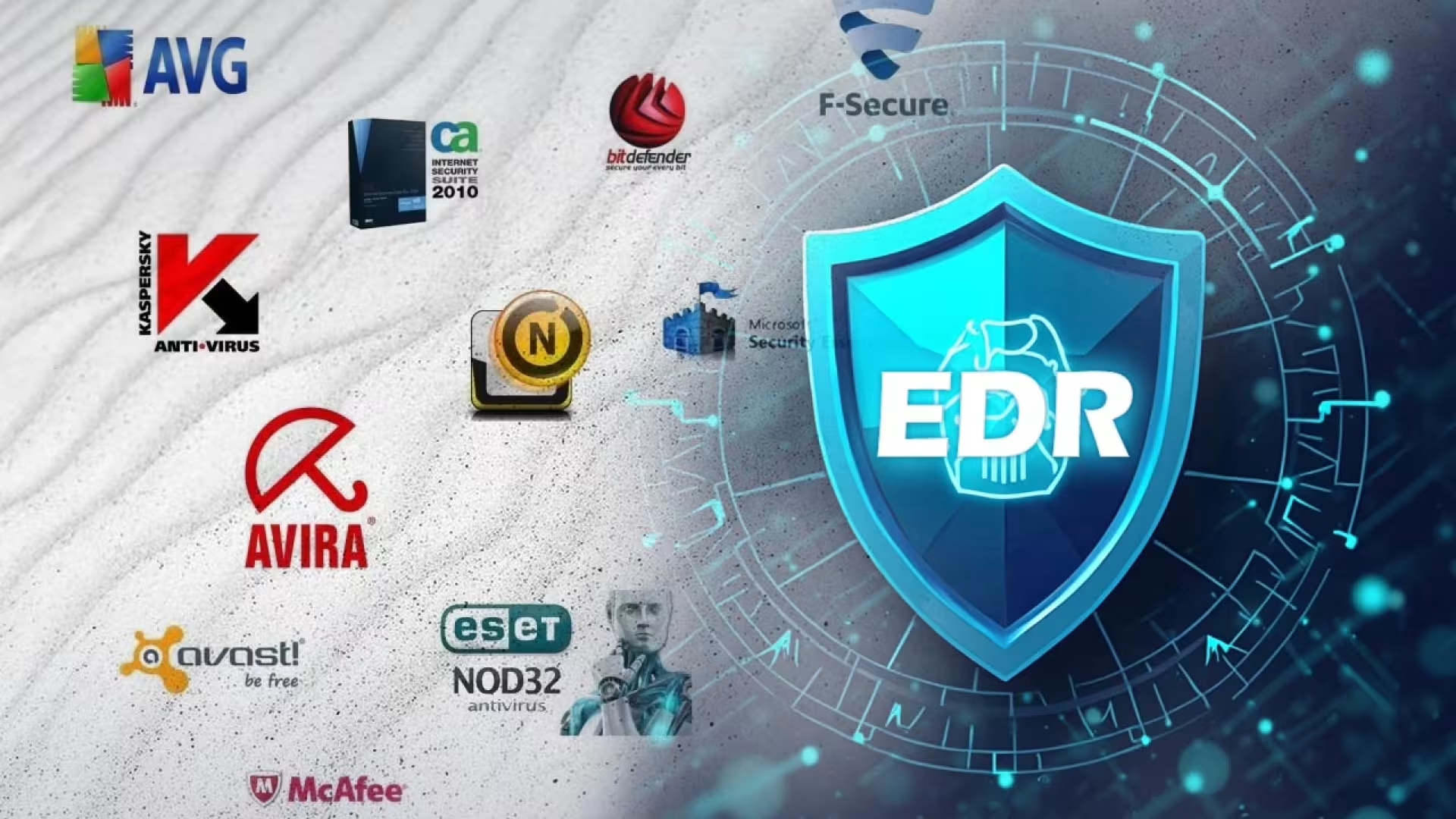
Antivirus vs EDR: which protection should you choose for your SME?

From Antivirus to EDR: Why VSEs and SMEs need to evolve

1. What are the limitations of traditional antivirus software in the face of today's threats?

Traditional antiviruses play a historic role in computer security, but they often prove inadequate in the face of rapidly evolving cyberthreats. They work mainly by signature detection: they compare files to a database of known viruses.

Although this can stop some attacks, this model shows its limitations when faced with so-called zero-day threats, which exploit unlisted vulnerabilities. Indeed, according to a recent study, around 80% of today's cyberattacks escape signature-based detection.

In addition, traditional antivirus products generally do not provide automated response mechanisms in the event of infection. Once a threat enters the system, the tool does not have the in-depth analysis capabilities to identify the origin or ramifications of the attack.

The ransomware directly attacks business-critical systems, and the antivirus, with its limited scope, can only protect to a certain extent.

This is particularly true for VSEs and SMEs, which rarely have dedicated cybersecurity teams to manage these complex attacks. A classic anti-virus is a necessary starting point, but it doesn't offer sufficient coverage for advanced threats. It then becomes essential to reassess security requirements to incorporate complete security solutions.


2. How does a modern EDR differ from a traditional Antivirus?

Modern EDR (Endpoint Detection and Response), such as SentinelOne, goes far beyond simple detection. Unlike antiviruses that focus on static files, EDR monitors activity across all endpoints in real time and analyses suspicious behaviour.

For example, if a file starts interacting in an unusual way with system processes, the EDR can intervene immediately, block the activity and launch an investigation.

One of the great advantages of the EDR is its ability to deal with unknown threats. By analysing behavioural patterns and using machine learning algorithms, an EDR is able to detect threats for which no signature yet exists. This proves essential in an environment where new threats appear daily. An EDR can not only detect anomalies but also react in real time, significantly reducing the impact of an attack.

For SMEs, another key benefit lies in the automation of incident response.

In the event of an attack, the EDR can isolate the affected device, contain the threat, and even automatically delete malicious files. This reduces reliance on a dedicated security team, while offering increased protection, essential for structures with limited resources.

3. Why is a managed BDU an essential investment for VSEs/SMEs?

The idea of investing in a managed ERD may seem costly for VSEs and SMEs, but it is vital protection in the face of growing cyber threats. Attacks no longer only target large enterprises; in 2023, 43% of cyber attacks targeted SMEs, which are often perceived as easier targets due to their lower level of protection.

The managed ERD allows enterprises to outsource security management to experts who monitor systems 24/7. In the event of an incident, a dedicated team is immediately available to intervene, minimising downtime and financial losses. What's more, managed BDU provides access to cutting-edge technologies without the need to recruit expensive in-house talent. This makes it a more affordable solution in the long term, compared to investing in specialist staff.

Finally, a managed EDR provides complete visibility of the security status of the business, with regular reporting and proactive detection of vulnerabilities. This helps anticipate threats before they even occur. For VSEs and SMEs, this peace of mind and ability to prevent incidents more than justifies the initial investment.

4. Why choose Cyber By Scutum's 24/7 managed BDU to protect your business?

Cyber By Scutum offers a managed EDR solution based on SentinelOne, a technology recognised by Gartner as one of the best on the market for the past five years.

With 24/7 monitoring by cybersecurity experts, the Cyber By Scutum offering guarantees continuous protection against threats. Simplicity of deployment is a major advantage for VSEs and SMEs: the software installs in just a few clicks on all systems, whether Windows, Mac or Linux.

The SOC (Security Operations Center) of Cyber By Scutum, based in France, provides real-time monitoring of incidents and offers rapid responses. If a threat is detected, the teams intervene immediately to isolate and neutralise the attack. Companies also benefit from regular reports, enabling them to monitor the security status of their IT park.

This managed service offers excellent value for money, with pricing tailored to the needs of VSEs and SMEs, starting at just a few euros per month and per terminal. Whether the enterprise has 5 or 500 terminals, Cyber By Scutum's managed ERD provides protection against cyberattacks, while limiting business interruptions and data loss.

Conclusion

Traditional antivirus is no longer enough to effectively protect companies. A modern, managed EDR, such as that from Cyber By Scutum, offers a complete and adaptable solution to the needs of VSEs and SMEs. Protecting your business is a major challenge today, and EDR is the key to achieving it.