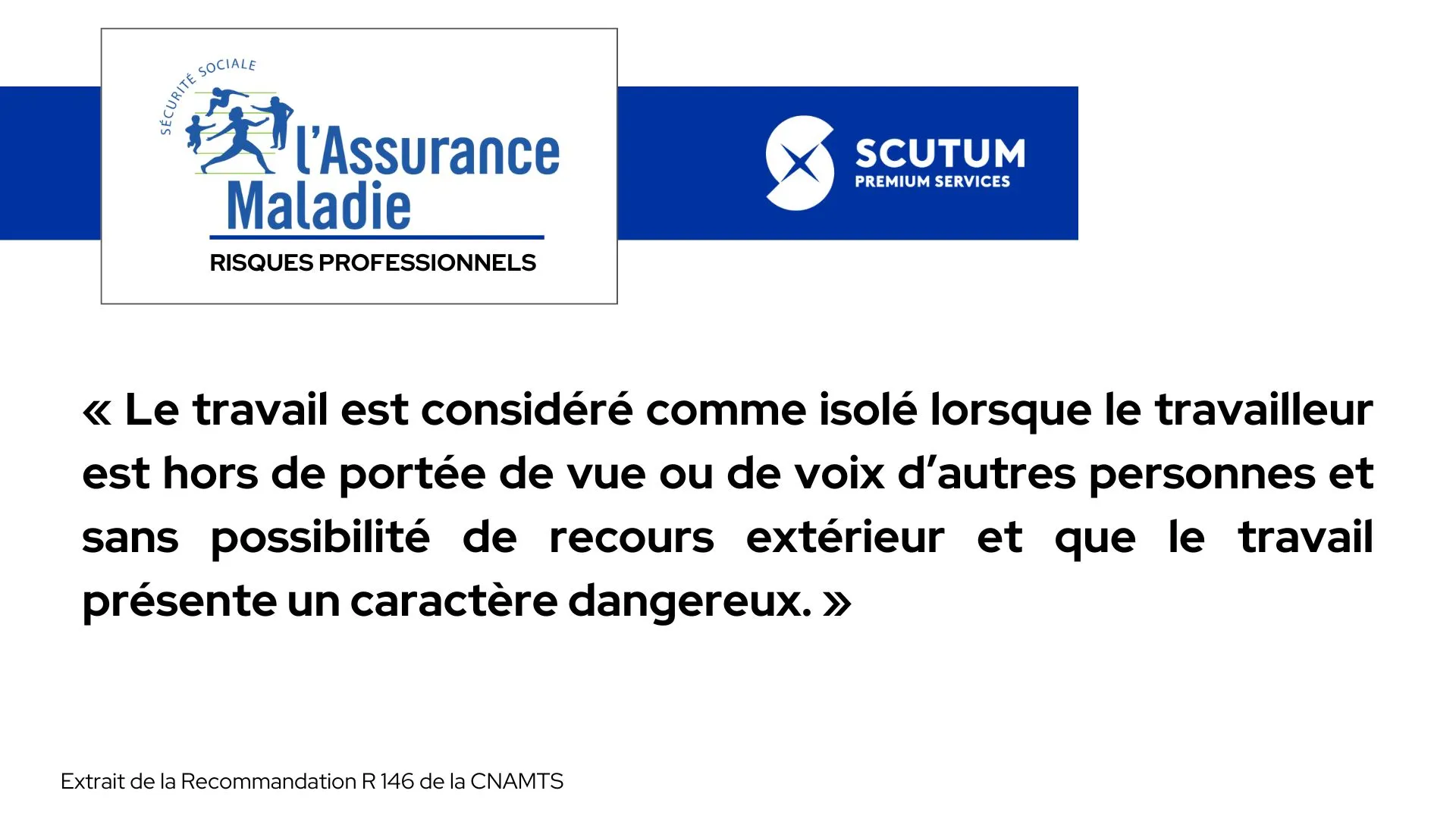
This definition of a lone worker is taken from recommendation R 416 of the CNAMTS (Caisse nationale de l'assurance maladie des travailleurs salariés). However, there is no official definition of lone working in the French Labour Code. This recommendation is therefore the reference to be used to identify isolated and dangerous work situations.

Publications
Isolated Worker What Definition
published on 09/01/2026
Isolated worker: what is the definition?
published on 09/01/2026
Written by editor
Written by editor
A worker is considered to be isolated when he or she is working alone, out of sight or earshot of any assistance, in a potentially dangerous environment.
Isolated workers: what are the issues?
The isolated work is not strictly speaking a risk. Nevertheless, this type of work context is much more prone to accidents. Behaviour and habits are not the same when you're working alone. It is therefore more difficult to detect an accident and rescue a lone employee.
This is why all employers must train and inform their lone employees about the procedure to be applied in the event of an accident in order to be rescued. The Labour Code also requires the employer to guarantee their protection.
What does the law say about lone workers?
Employers are responsible for ensuring the safety of their employees and keeping them in good health at work. The Labour Code does not provide a precise definition of a lone worker. It is very clear, however, on the measures to be taken to supervise their work. Employers must identify the risks faced by their lone workers so as to guarantee their rescue in the event of an emergency.
What are the risks for lone workers?
Isolated working amplifies the dangers for employees who find themselves alone once at their workstation. They are likely to be unable to sound the alarm in the event of an accident, for example, or not be spotted quickly if they feel unwell. Ultimately, there are many risks. It is therefore important to identify them clearly and carry out a risk assessment:
Discomfort: your employee may feel unwell and have no-one to come to their aid,
Accidents: your technician has to work at height and may suffer a fall,
Aggression: your employee finds himself late in low-traffic areas,
Incivilities: your receptionist finds herself alone and may be confronted by angry customers.
Who qualifies as a lone worker?
A lone worker is not always an employee working in a high-risk or extremely dangerous job. Each employer must then refer to the CNAMTS definition. They therefore identify all their employees working in isolation, out of earshot or sight of their colleagues. However, we can identify certain sectors more often confronted with risks: technical services and maintenance, industry and logistics, social and voluntary work, local authorities and points of sale.
How do you protect a lone worker?
Your isolated workers have all been identified. You then need to list all the situations that pose a risk to your employees, whether one-off or recurring. You must then prevent these risks and implement your lone worker protection plan. Lone working is then reduced to a minimum.
Also, you need to put in place a warning system adapted to their activity so that they can be rescued in the event of an emergency. This individual protection goes hand in hand with a suitable rescue organisation that is available and responsive throughout the period of lone working. These preventive and organisational measures will ensure that your employees can be rescued as quickly as possible.
Security measures and organisational measures will ensure that your employees can be rescued as quickly as possible.
Which alert system should I choose?
There are various types of alarm system for lone workers. You must therefore choose, with full knowledge of the risks involved and the contexts, a device that does not hinder the smooth running of the activity. For example, if your employee is faced with the risk of being attacked, you need to provide him or her with a device that allows an alarm to be triggered discreetly.